Klute


1971 hooker mystery

Rating: 15/20

Plot: The titular detective looks for a missing friend and gets help from a prostitute.

It's unclear why Jane Fonda won an Oscar for this and wasn't even nominated for her superior performance in Barberella.

I just spent the last fifteen minutes looking at pictures of Jane Fonda. That was time well spent, but now I'm pretty tired.

You know what else is unclear? Why is this movie named after Donald Sutherland's character? To me, it seemed this was more about Bree Daniels' story than Klute's.

I have a couple of favorite parts of this movie, but I don't want to talk about them. They have nothing to do with the mystery that Klute is trying to solve.

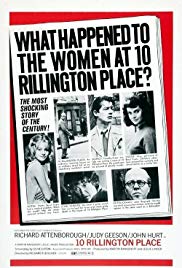
10 Rillington Place


1971 killer movie

Rating: 15/20

Plot: The dirty deeds of a British serial killer are blamed on a neighbor.

This film about a real-life serial killer in this titular English address is less concerned over the grisly details of his murders and more concerned with the effects of impulsivity with investigations about these sorts of things. Murderer John Christie is at the center of things, of course, and the movie does take its time to show you his procedures as he stalks, plans, and kills, but the story's main conflict has more to do with the character played by a very young John Hurt.

The actual murder scenes are creepy because of the mousey Richard Attenborough's quiet performance and the matter-of-fact way he goes about his business. He plays the character with this strained mild mannerism that really gets under your skin. More than any movie I can remember, Attenborough creates a character who personifies dark secrets while seeming like the sort of person who could be your neighbor if you live in England or happen to have a neighbor who speaks in an English accent. It just feels a little too real, and adding to that realism is the fact that this was filmed at the actual address of these crimes.

Here's another note I wrote down but couldn't understand: the word "barrel" with a question mark after it. I figured that one out though. John Hurt's character's wife was named Beryl which, until I watched this, I didn't realize was a name. Darryl? Sure. Meryl? Yeah, I know that one. But Beryl?

I just looked up famous Beryls because I have nothing better to do with my life. There are a few, but I didn't see any A-listers on there. I think if you name your child Beryl, you're really not helping him or her out.

Demons


1971 drama

Rating: 16/20

Plot: Hell hath no fury like a samurai scorned.

The world is a sea of blood as our scorned hero goes cray-cray and chops some people up. A transition from a color sunset to black and white is jarring but not as much as the twists that director Toshio Matsumoto throws in his storytelling. The story is a simple one of revenge, but there are some avant-garde shadings and some of the bleakest imagery you'll ever see. This isn't your typical samurai picture. This one is brooding and nihilistic, a world without any good guys with swords and with limbs strewn all over the place.

The Old Man and the Gun


2018 crime drama

Rating: 15/20

Plot: An old guy robs banks with Tom Waits and Danny Glover.

Anybody who knows me knows why I was excited about this movie. It had nothing to do with it being Robert Redford's swan song and everything to do with the appearance of Tom Waits, one of my favorite human beings. Waits is fun here, and David Lowery gives him one moment to shine by allowing him to do what he does best--tell a story. Like the pie-eating scene in Lowery's ghost movie, hearing Waits' character talk about why he doesn't like Christmas is an unexpected bit of genius.

Redford ends his career with a bang if this really is his final movie. His beautiful eyes, that mischievous smile, and that natural charm are probably enough to carry a movie like this, but his old man is such an intriguing character and the period details are so good. There's a developing romance with Sissy Spacek that ironically works like a temptress, drawing him away from the life of crime that he is more naturally drawn to.

After this movie, a couple of middle-aged women who were sitting in front of me and annoyingly talking throughout the movie, were talking about Tom Waits. They knew the name but didn't know who he was and were looking up his filmography on the phone. One of them thought he was black. I chimed in, but they didn't seem impressed with my list of top-25 Tom Waits songs that I have stored in my memory just in case there's every a situation where that is needed.

This might be the most 70's 2018 film of the year, but I'd have to think about it.

The Decameron


1971 sex comedy

Rating: 15/20

Plot: Filthy stories.

"Why create a work when it's so beautiful just to dream it?"

I was going to write something intelligent about Pier Paolo Pasolini's arsty potty humor, but I'm distracted by a shot with nuns looking out of windows, the alliteration of the director's name, Eli Manning's nightingale, and all that jaw harp.

This movie has the strangest collection of teeth.

Get Carter


1971 crime movie

Rating: 15/20

Plot: A gangster tries to get to the bottom of his brother's death.

Whenever I attempt Michael Caine impressions, I'm going to try saying "Albert Swift" over and over again.

I had an entire paragraph typed here, but I decided to delete it because it was a little too bleak.

On Any Sunday


1971 motorcycle documentary

Rating: 15/20

Plot: Motorcycle racers compete in a variety of motorcycle races.

I have no interest in motorcycles or racing of any kind, but this documentary from Bruce Brown, the guy who made the surfing documentary Endless Summer, is just so watchable. The cheesy narration that reminded me of film strips I watched in school as a kid and the cheesy music made this the documentary equivalent of candy. I enjoyed the personalities followed around the country, risking their bodies as they hurtle themselves through rugged terrain on these little machines. Fighting through injuries and pain and devoting themselves to this craft would make them seem like maniacs even if there was hefty prize money or glory to be had. These guys are doing it for far less than that although the sheer joy of doing it might be better than either money or fame. That's most evident in a beautiful series of shots at the end that show a trio of riders, one of them being none other than Steve McQueen, just riding along a beach for no reason other than being together and riding on motorcycles.

There's great footage of the various kinds of races. I enjoyed all the slow-motion shots of riders with the soles of their feet touching the ground as they round curves, but the marathon desert race would be the one I'd most want to take part in. I also enjoyed scenes from riders trying to ride up the side of a cliff.

The Hospital


1971 hospital movie

Rating: 15/20

Plot: The director of a hospital tries to hold it and his life together.

Man, is George C. Scott good in this as this character who's molded by his situation. Scott plays depressed, alcoholic, horny, frazzled, suicidal, mildly hopeful, and determined, and he plays it all convincingly. He's nervous breakdown incarnate. In a way, he's an actor who is playing a character who doesn't realize your life, your marriage, and your career are just all one giant dark comedy. There's a mystery at the center of this hospital drama, but the solving of that never seems quite as vital as what's going on in George C. Scott's head.

Paddy Chayefsky wrote this thing, and there's a real zing to the dialogue, especially between Scott and the fetching Diana Rigg.

The Point


1971 animated fable

Rating: 14/20

Plot: A round-headed kid in a pointy-headed world is ostracized and finally banished, so he walks around the forest and has adventures with his dog.

Crude animation with some cheapo sketchy psychedelic brings this simple fable about bigotry. It reminds me a lot of the old Tootsie Pop commercials with that owl who's a giant asshole. If you're my age, you know exactly what I'm talking about. This movie was before our time, but the ideas are unfortunately timeless ones. In 2018, we're still ostracizing people who don't have pointy heads.

The real star of the show is probably the Harry Nilsson songs. As a Nilsson fan, I heard the music for this long before I saw the movie. This is also Nilsson's story although I'm not sure if he's responsible for all the silly attempts to make "point" puns. Actually, there was a lot of attempted word play here that didn't work at all, almost like it was written by somebody who only sort of understands what word play even is. Anyway, the songs work. The melodies match the crude and childlike look of the animation even if the songs all kind of sound the same. If you like Harry Nilsson, you won't mind that.

So this is a movie for anybody who loves watching those Tootsie Pop commercials and listening to Harry Nilsson.

Beware of a Holy Whore


1971 German movie

Rating: 15/20

Plot: Some people try to make a movie.

Maybe I didn't like this, but it's apparently one of Bob Dylan's favorites which forces me to give it bonus points. We learn that pride goes before the fall with this near-story about a purgatory disguised as a movie shoot. I've seen an alarmingly small number of Fassbinder movies, but I still consider myself enough of an expert to find an opening soliloquy about Goofy to be somewhat shocking.

Knowing how bad I am about writing these things, I've been jotting down notes. For this one, I have two notes that I don't understand. The first just says "jukebox." I know what a jukebox is, and I remember a jukebox being in this movie. I think all the music is actually from that jukebox. But I'm not sure why I would have just written down that one word. What's going on there?

The other is "sleep aids." I have no idea what that's all about, but it must have been important because I put a box around it and wrote it in all capital letters.

This starts with that Goofy soliloquy and ends with this fantastic shots on stairs, a newspaper and characters leaving one by one. In between, the first half consists of all these tiny sketches, these vignettes with all these extended shots. There's a sneaking choreography as the camera moves through the characters. By the end, things are more frenetic. The settings change rapidly, and the shots aren't nearly as long. There will be a brief snippet of conversation, and then, as if somebody has magically snapped his fingers and made it happen, the scene shifts to a new location and a new conversation.

Sleep aids. Huh.

A Star Is Born


2018 musical drama

Rating: 12/20

Plot: A drunk alternative rocker has-been meets a talented singer and helps her become a star.

This is a story that's been told many times, and it's not really told all that convincingly here, but I did like how they fell for each other. Both characters fall for the other's vocal stylings, both Cooper and Gaga nearly getting O-faces as they hear the other one sing for the first time. Their rapport works without being obvious although it is better in the first half of the movie, probably something that was deliberate.

I didn't really like either of these characters even though I liked both performances. Gaga really is a star. Without a doubt, she's got the singing chops to pull this off, but she really shines in her ability to do so much with a character who is fairly disappointing. Cooper grumbles his way through the movie. Or maybe he Sam Elliotts his way through it. He's got this natural charm that makes the character lovable even when he's skimming rock bottom. A scene with eyebrows, scenes where he's goading Gaga, and times when the character is allowed to be playful really makes it easy to see why Gaga's character would fall for him. Was Cooper's character supposed to be a little dumb though? He seemed a little dumb.

I don't know what to say about the music. I didn't like it, but I'm not really the right person to ask about contemporary alternative rock that sounds like it might have come from the late-90s or whatever sub-genre of pop music Gaga is performing. The allure of Gaga's voice might save some of the songs, but I didn't really fall in love with any of them. A couple of weeks after seeing this movie, I can at least remember one of them, but that might be the result of it being in the movie about a dozen times.

Very likely, this is just a romantic story and nothing deeper. If you have to look for a theme at all, you would wonder if this is about the destructive force of choreographed dances in pop music performances. Or maybe something about how alcohol is more addictive than love.

I might not have fallen in love with this like most everybody else has, but I did seem to like it more than the couple who fell asleep down the row from me and snored during the final 45 minutes of the movie. I thought it was just one of them who fell asleep, but when the lights came back on, they were both asleep. I was the last to leave the theater other than them and probably could have woken them up, but I decided to take a picture of them instead.

Red Sun


1971 western eastern

Rating: 14/20

Plot: An outlaw teams up with a samurai in order to retrieve a priceless sword and some stolen cash.

This is Charles Bronson and Toshiro Mifune teaming up to look for a priceless kitana, some stolen money, and a little revenge. That's probably all you need to know. If you really think about it, Bronson and Mifune is a perfect match on paper, and they're a perfect match out in the barren desert wherever this is shot, too. Western bravado and loud guns clashes with quiet and graceful swordplay of the East, and it's fun watching those two ideals skirmish on screen and these two manliest of men match wits.

The Hellstrom Chronicle


1971 mockumentary documentary

Rating: 15/20

Plot: A fake scientist explains how bugs will wind up outliving people.

So the scientist in this might be completely fake, but the message--that the insect world, savage and resilient, will be around long after we superior humans have scienced ourselves into oblivion--certainly is timely with very real scientist making terrifying pronouncements about the doomsday clock and very stupid politicians ignoring the whole thing. Man, I dig that scientist guy, the titular Dr. Hellstrom played by Lawrence Pressman. You're just about duped that he's this scientific prophet of the apocalypse even with the poetic narration, all the talk about how "Life must take life for the sake of life itself" or "Learn the inevitable destiny of ignorance" or something being "as limitless as the imagination of the insane."

The real star of this faux-documentary-with-an-actual-documentary-hidden-inside would be the insect photography. The whole thing begins lava-tastically, a scene that can only be described as lava rape. From there, you get these impossible close-ups like in Microcosmos or The Besieged Fortress, and if you like either or both of those, there's more than enough for you to love here, too. Almost impossibly beautiful, these time-lapse shots or tight shots on insects could almost fool you into thinking CGI was involved. It wasn't though because Dr. Hellstrom would never lie to you.

This would make a great double feature with The Day After, that TV movie about nuclear apocalypse. Insects, you feel, will giggle at our corpses after we're gone. Dr. Hellstrom tried to tell you so.

Fahrenheit 11/9


2018 propaganda piece

Rating: 12/20

Plot: Michael Moore takes America's pulse, focusing on the Flint water situation, the Trump presidency, how terrible everything is, and how there might be a reason to have hope for the future.

But probably not because everything has been consistently terrible for so long and will likely be terrible for a long time after I'm gone. As much as I know that Michael Moore's documentaries are pure propaganda and as much as I have to admit that if this guy was on the opposite side of politics as me that I would despise him and his baseball caps, I looked forward to this one because I really enjoy his work. There's a levity to the dooming and glooming to make it all easier to swallow, and I enjoy having my core beliefs validated and maybe even learning a thing or two.

Maybe it's a sign of the times, but this movie really depressed the hell out of me. This was a nearly devastating. A look at the Donald Trump robot being constructed for Disney's Hall of Presidents--at least I think that's what was going on--was probably depressing enough, but the first ten or so minutes that retells a story of Trump's inspiration to run for president and his pummeling of the other Republican nominees and then final surprise victory on election night was difficult to watch. If I didn't already know the ending, it might have been even scarier than Hereditary, and I can't say it's footage that I really cared to revisit again. It felt like a prelude to the apocalypse as it was happening, and it feels like that now.

It's not all focused on Trump though. Trump might be more of a centerpiece of a whole smorgasbord of problems with America, but he's not the lone target here. Moore does spend time with Trump, and he does in the exact way you'd expect him to, that way that would even make some liberals give him the old side-eye. When he brings Hitler and Nazis into the whole thing, the propaganda is a little hard to swallow. Until it really comes together that is. When the rhetoric and imagery really converge well, it just makes what you're swallowing sick to your stomach. It's a convincing argument, but it's possible that my level of intelligence makes me the perfect target for stuff like this. I'm not so sure about the links to 9/11 and the Reichstag fire though.

Stuff about Ivanka was both gossipy and unnecessary. I wish that would have ended up on the cutting room floor.

I can't remember the last time I saw a Michael Moore film, but I don't remember the tone being this angry or hopeless. There are definitely less stunts than you might expect. There's the one with a tanker full of Flint water that he sprays on the mayor's tree, and that falls completely flat. Other than that, I can't remember any stunts. Where I think Moore excels is when he just talks to people. Again, it's possible that I'm just being duped here, but he and his hat really seem to be listening to the people he's conversing with. He's not just hearing, but he's listening, and he's doing it with some part of his being that those in power seem to lack.

There are so many threads here, but this is most successful when he's explaining the situation with Flint's water. And when it gets to the point where it's referred to as "systematic genocide," I had no choice but to believe it. You see images and hear about corruption that makes you shake your head and say, "No, there's just no way this is America." I experienced waves of emotion throughout this thing, but I was especially disturbed and saddened by the filthy details of that filthy water situation.

And he's not just pointing a chubby finger at one party. Nobody is safe here, and that includes Obama. Watching Obama's trip to Flint unfold here in the exact way that Moore usually unfolds his tales was a major bummer. He's critical of both sides of the aisle, appropriate since it's really the system as a whole that is failing a lot of American citizens who have no reason at all to ever think that this country was great.

But no, it's not all catastrophe and doomsday. If there's a theme at all here, it's that there's hope to be found in people who are resisting this failed and failing system. There's hope in the youth who are demanding that something should be done about kids being shot up in schools. There's hope in the social media warriors fighting against everything that's broken. There's hope in fresh faces running against the establishment.

I'm not sure the hopeful and more enthusiastic tone that started to break up things in the last quarter of this was enough. I still walked out of the theater with tears in my eyes because as a portrait of my country, this was very dark and dismal. But at least it was something.

Blaze


2018 musical biopic

Rating: 15/20

Plot: A look at a not-so-famous country artist and his life, his love, and his unfortunately short career.

Musical biopics ain't my thing, but if you throw in Townes Van Zandt as a character, my interest will be piqued. That guy very well might be on my own personal musical Mount Rushmore along with the three other sure things. He's at least one of a rotating fourth. I can thank Larry and Lyle Lovett for that because I didn't really know who he was I was way too old to be finding out who Townes Van Zandt was.

Blaze Foley would not have been nowhere near my musical Mount Rushmore because one requirement to be memorialized in my mind's stone is that I need to know you exist. Like most people--even folks who like country music way more than me--Blaze Foley is relatively unknown. Knowing that Townes Van Zandt was a champion of Foley's work piqued my interest, and I was very happy to find out that Van Zandt himself was an important character in this biopic.

My favorite moment might be one of the snippets of a radio interview between Van Zandt and a DJ played by Ethan Hawke who directed this thing because starring in a great movie and another pretty good one wasn't enough for him in 2018. Townes tells a story that involves grave robbing and a pawn shop loan slip that was just about the best thing I've ever heard. Charlie Sexton gives an earthy performance as Van Zandt. His story doesn't distract from Blaze's story, but he's an integral character, and it was great to see him.

As you might expect, there's a lot of music here, and some of the best moments are Van Zandt's. There's one great song he gets where the characters are bathed in this yellow light and lens flare, giving the whole scene an almost magically realistic look. It's beautiful, and there's another touching moment where Blaze brings himself into a performance by his friend that was downright touching. Blaze is played by Ben Dickey, and as a professional musician, he brings a legitimacy to the live performances. If this was Elvis or Chuck Berry or Johnny Cash, the viewer would come in with certain expectations. I'm not sure if Dickey's Blaze is spot-on or not or if he's creating a character who is only almost Blaze and not quite Blaze. It doesn't matter because his musical performances get to a certain depth and help round out this character.

Dickey is really good. There are a lot of good moments, some that would even fall into your typical biopic trappings. You buy him as a musician, and you buy him as a storyteller. You buy him as this giant gregarious bear of a man with troubles burbling beneath his fur. You buy him as a romantic soul and as a sometimes-angry man and as a self-destructive drunk. You buy this guy as a folksy philosopher with these wells of wisdom that you wish he would draw from. Blaze is a character you root for despite his flaws and maybe even because of his flaws. You recognize the genius, identify with the demons, and are attracted to this magnetic personality. Dickey hits a range of emotions in creating this figure who should have been a limping icon.

Hawke's storytelling is disjointed, and for the better part of the movie, I couldn't figure out why that was necessary. In a way, it matches the structure of a live show with Blaze doing some songs, going off on wild tangents, taking time to engage in fisticuffs with a punk who's talking on the phone of this dive serving as a venue a little too loudly, and then getting back to what is normally expected in a live show. Clinking bottles and inebriated chatter add flavor just like little detours in Blaze's life narrative. This narrative bounces around between that radio interview with Van Zandt and Blaze's posthumous influence, the live show recorded just a day before his death, and all of the little episodes that make up his climb to anonymity.

The last one-fourth, from the part right around where his wife is gone until the end, is a little more draining because the character goes to some pretty comically dark places that you wish he wouldn't. And there's a death scene in this--not a spoiler since it's given away right off the bat--that is probably a little longer than it needs to be. I thought it was more effective when it was just a suggestion, a sickening sound that we could identify anyway. I didn't need to see Dickey suffering to know that Blaze Foley had a sad and painful death.

Something in this might give another recent pick for "Song of the Year" a challenge.