Certified Copy


2010 drama

Rating: 17/20

Plot: While visiting Italy, an author meets a single mom who owns and antiques store, and she agrees to drive him around for some sightseeing.

My assessment of the work of Abbas Kiarostami was off. I'd only see two of his movies--Taste of Cherry and Close-Up--and while I knew that he can be meta and blur the line between film and reality, I went into this expecting something a little dry, straightforward, maybe minimalist. Early on, I was comfortable enough. The motivations of the two characters as they begin this journey together wasn't clear. Was she going to attempt to seduce him or was there something about him or his writings that had wronged her, causing her to have some sort of vendetta against him? Was he bored, horny, a combination of bored and horny?

For the first chunk of movie, I felt I had a handle on this Before Trilogy-esque developing romance or whatever it was, and I was trying to piece together themes having to do withoriginals and copies, living simply, hedonism, the nature of art (cypress trees and Coca Cola), and children as miniature philosophers. So at a key moment when a kind of twist appears, I was surprised, and I ended up watching the rest of the movie with my mouth wide open.

Of course, that's usually how I watch movies anyway. It's why I stopped going to theaters. Kids kept tossing popcorn into my open mouth as some sort of childish game, and on two separate occasions, I nearly choked.

So I guess I had forgotten how avant-ornery Kiarostami could be, how playfully tricky. Because during the rest of this movie, I got a stress headache from trying to figure out exactly what I was seeing, what clues I likely missed, and what it all meant.

I still don't know! But I haven't stopped thinking about it since, finally figuring out that I'm not supposed to understand the nature of these two characters' relationship or at which point in the movie they're playing some elaborate game of grown-up pretend.

Juliette Binoche is something else. Every time I see her in a movie, I'm surprised at how good she is, how she very well might be one of the greatest actresses who's every lived. She's emotionally all over the place, one of those performances that seems like it would take a lot out of an artist. She won best actress at Cannes for this, and I imagine whoever decides the winners of those sorts of things probably only needed to see the one scene where she puts on lipstick to decide that. William Shimell compliments her very well in what apparently was a first movie role for him. Kiarostami gives us intimate looks at these two, a lot of shots having them speak directly to the camera. And while the sights on their sightseeing tour really are beautiful, the focus is rarely on any of them. Heck, even a key statue that becomes the center of the dialogue at one point is never really even seen.

So a faux character study with plenty of philosophical red herrings, twisty and filled with mirrors and repeated lines and doppelgangers, Certified Copy is a reminder that I need to start paying more attention to the filmography of Abbas Kiarostami. And not underestimate how ornery he could be.

I Saw the Devil


2010 revenge thriller

Rating: 8/20

Plot: After a serial killer murders his girlfriend, a guy seeks torturous revenge.

You feel every bit of this movies 2 hour and 20 minute running time. I think what I watched on a popular streaming site may have even been abridged because when I looked the movie up on Wikipedia to help clear up something in the plot synopsis, I noticed a sex scene mentioned that I didn't get the chance of enjoying. I can't think of any reason why this movie needs to exist at all, so I surely can't think of any reasons why it would need to exist for 2 hours and 20 minutes.

I have no issues with violence in movies, and sometimes, as sick as it might sound, I even enjoy a bit of it. With the violence in this, you just have to wonder what the point is. Jee-Woon Kim, as a director, seems to take great pleasure in inflicting violence upon his characters, especially women. There's a big difference between the way violence against women is shown compared to most of the violence against the men. The scenes with men are flashy, filled with quick edits and a cartoonish chaos. The male characters, up until the points where they lose their entire heads, dust themselves off and limp off to see another scene, almost like they're in a Warner Brothers cartoon instead of something that is supposed to be taken seriously.

The violence toward women, on the other hand, is shown differently. Kim really seems to enjoy watching the female characters in great distress, the camera lingering on these moments so that we realize they're not just going to be able to dust themselves off again but have to deal with the psychological trauma for the rest of their lives. If they have any more life left, of course. You know how this movie could have been a lot shorter? Less slow scenes where the director seems to be punishing the gender for the sins of girls who didn't return his attention in high school. And that panties shot, Kim? How necessary was that one?

The violence is graphic and the special effects involved in making it appear as if actual human beings are losing body parts or being pummeled or perforated are good enough for Kim to show on the screen for three times longer than they should be shown. There's a nice sense of style with some of these scenes--some lovely stylish shots when a character gets stabby in a taxi, for example--but the stylish slow pans or close-ups of cigarettes being lit or whatever started to wear me down as much as the ultra-violence after a while. At one point, we get to watch a character dig around in his own shit for something, and by the end of this tale of "real revenge, true revenge," it started to feel like I was being asked to do something similar.

Lingering questions: Why does the cannibal guy have such a hot girlfriend? And how did our main serial killer even befriend the cannibalistic serial killer? Aren't they supposed to be loners? Did they meet up after connecting on a message board or something?

Beginners


2010 romantic comedy

Rating: 14/20

Plot: Following a shocking announcement and the death of his father, a guy taking care of a needy dog meets a new love interest.

This might demand a little more intellectual attention than I was willing to put into it. My mind thought I was watching a romantic comedy, so I think it might have shut down a little too much. There are some pieces to this that don't seem to fit narratively or thematically, and it's possible that that's entirely my fault.

Time comes up again and again, for example. What's all this time business?

I also felt like I needed more time with some of the characters' relationships. None of them--and that probably includes the Jack Russell terrier's relationships--have enough time to develop in satisfying ways. I thought the romance at the heart of this, likely because we're seeing this from Obi-Wan's perspective and know exactly where his mind's at, made sense from his side of things, but now I'm not convinced it wasn't as superficial as me also being smitten by a quirky-cute Melanie Laurent. She's apparently attracted to moping. Plummer, I suppose, is just horny. Goran Visnijic, as his boyfriend, had a haircut that I didn't trust, and I kept waiting for something nefarious to be revealed about him. When it wasn't, it was hard to pin down exactly what that character was about. And then there's the mother, another character I just couldn't pin down.

Maybe pinning down the characters isn't what this is about. And maybe it's not what any movie is supposed to be about. I enjoyed seeing the characters interact, the leads are very likable and one of them might even be lovable, the offbeat score adds a nice flavor, and that dog is stinkin' cute. Sometimes, the quirky asides and narrated bits are a little distracting.

I wonder if this could have worked better as a television mini-series.

Meek's Cutoff


2010 Western

Rating: 15/20

Plot: Folks venturing west in covered wagons start to doubt their guide, a shaggy hippie named Meek. Things get more complicated when they collect a Native American.

I know exactly why I've avoided this movie for so long--it's because the poster tricked me into thinking Renee Zellweger was involved. That's not her at all--it's Michelle Williams.

I finished this movie not thinking I liked it very much at all but convinced myself on a drive to the grocery store that it's better than I thought. It's easy to appreciate how economical Kelly Reichardt's storytelling is, and although initially I wondered if a lot of what was happening or being said in this movie was either redundant or inconsequential, the more I think about it, the more I think every single little detail in this might matter.

That includes the squeaky wagon wheel.

A couple lines of dialogue in here key the viewer in on what this is about, and what it is about seems just as important to America today as it is to these characters in this specific manifest destiny situation. There's a feminist reading of this, female characters often pushed into the background while men wrestle with manly decisions. They sew and wash and do traditional womanly tasks while the men discuss whether to murder people or grow facial hair. The difference between men and women is discussed by the titular guide, but his description of women as agents of chaos and men as agents of destruction didn't make a lot of sense to me.

Another line has to do with Meek himself and whether he is ignorant or evil. You're forced to wonder if certain kinds of ignorance are forms of evil. He does seem to be an expert on hell, however, telling the other characters at different times that "Hell's full of bears" or that "Hell's full of Indians" or that "Hell's full of mountains." Like the other characters on this journey, you get no information at all on anything that took place before the movie started, but you do get the feeling that he's seen some version of watered-down hell and hasn't learned much of anything from the experiences.

Another piece of dialogue I liked during one of the sewing scenes: a reference to all the things that white people have created that are even more impressive than needles.

One thing I didn't like much was the acting and the general look of these characters or their covered wagons. This lacked authenticity, almost like the actors were working at some kind of living history museum instead of making a film. I did kind of like Bruce Greenwood's performance even though what he's doing kind of clashes with the lack of voice the rest of this has. Maybe that's part of the point.

I'm going to think about this one a little bit more, probably because I'm as persistent as a squeaky wagon wheel.

Incendies


2010 drama

Rating: 14/20

Plot: Following the death of their mother, twins have to find a father they thought was deceased and a brother they didn't know existed.

Confusion about some characters' motivations and way too many references to math got in the way of me completely feeling this movie.

I'd tell you the movie this reminded me of, but I think that would probably be too much information.

Nostalgia for the Light


2010 documentary

Rating: 16/20

Plot: Filmmaker Patricio Guzman looks into the work of astronomers, archaeologists, and women searching for their loved ones' remains in the Atacama Desert.

The Atacama Desert--that spot of brown you can see on earth when looking at it from space, the driest place on the planet, a Mars-like terrain where a translucent heaven makes it a perfect place to search the cosmos. I'm pretty sure I could have just watched a documentary on the Discovery Channel or something about the desert, but director Patricio Guzman has other things in mind. This is a documentary about time, about memory as a gravitational force, about the pain of absence or loss, about where we come from and where we've been, about how a puff of air is capable of destroying a present that might not even exist, and about the stars' ability to preserve inner freedom. The Atacama Desert, it just so happens, is the perfect location for a documentary essay on those things because you've got all these scientists with their giant expensive telescopes taking advantage of the aforementioned translucent skies to get answers about our past while all these women are searching the dry grounds for answers about their own individual pasts. It truly is, as the filmmaker suggests, a "gateway to the past."

I have no background at all on Pinochet or Chilean history. You probably don't either, but you know what both of us can enjoy? Space porn!

The use of space dust (or something) was maybe overdone, but there are a lot of beautiful shots in this thing. My favorite shot was probably a dark silhouette searching the ground with a lone star in the dusk sky. It's the kind of shot that pretty much captures everything this movie is trying to say.

Like Did You Wonder Who Fired the Gun?, another documentary about dark times in a country that the country hasn't quite shaken off yet, this depends a lot on visuals and has a lot of narration. They have some things in common stylistically. This one's much, much better though.

I don't know why I'm bringing that other documentary up. It doesn't seem very nice to pick on that movie while writing about this movie.

Le Quattro Volte (The Four Times)


2010 movie

Rating: 16/20

Plot: An old shepherd coughs on his goats. Anything else would spoil the movie!

Shepherd? Goat herder? Can you be called a shepherd if you're not working with sheep? The more movies I watch, the less I seem to know about the world.

By the way, how does one direct a goat? Or a dog? Or a tree? Because I'm pretty sure all those non-humans are being "directed" here.

Michelangelo Frammartino is not a filmmaker with whom I am familiar, but you can tell from this that he doesn't know you're allowed to use music in a movie. The only sound heard in this would be the wind and goat ambiance. Mostly goat ambiance which, I found out, is capable of making me giggle. That lack of sound does include, you should know, any audible dialogue. The goat herder coughs a whole lot, and there's some background chatter (and lots of goat chatter) but none of it must be very important since there are no subtitles provided. There aren't any for the goats either. Or the tree.

So this requires a lot of patience, but you need to pay attention to the smaller details. Otherwise, you're going to miss a trio of flies. You're not going to miss the stand-out scenes--a game of "King of the Hill" with goats, a goat birth, tree hoisting--but you might miss those flies. And those flies are important!

You definitely won't miss the most impressive shot I've seen in a very long time, a Tati-esque look at the little village preparing for some sort of Easter procession thing, the Easter procession thing, dog hijinks, a truck doing a truck thing, and those goats doing some goat things. It's all in an unbroken 8-or-so minute shot that I can't believe was pulled off. It might be the most amazing thing I've ever seen in a movie about goats.

Anyway, I don't want to spoil anything. If you have the patience for a movie like this (it really reminded me a lot of Hukkle if you know that one), see this and explain what it's all about. I thought it was about reincarnation or something. Wikipedia tells me it's about some theory of Pythagoras, but I can't recall triangles being important to this at all.

This is my new favorite movie!

The Fighter


2010 boxing movie

Rating: 12/20

Plot: Put all the other boxing movies in a blender, add in a wacky Christian Bale, and throw in an extraneous scene where characters admire Amy Adams' posterior in a pair of cut-offs. Pour in a glass. That's The Fighter.

I'm catching up with movies I missed from 2010. This was missed because I was completely wrong about Christian Bale and thought he was a terrible actor, didn't like Mark Wahlberg at all, and didn't think anything in here could possibly justify its existence as yet another boxing underdog story. And at first, it seemed as if I was wrong. The movie seemed to have the kind of personality that could help it stand out from all the other boxing movies. It was lively, and there was some humor that I didn't expect.

Unfortunately, you realize that almost all the initial momentum is provided by Christian Bale and the eccentric character he's transformed himself into. He's part of an oddball cocaine-fueled collection, and his gaunt appearance, hyperactive physicality, and sketchy-looking bald spot help him fit right in. He moves and punches well enough to be convincing enough as a washed-up, strung-out former contender, and he's simultaneously dangerous and loving enough to almost make what is supposed to be the emotional pay-off to this whole thing work. His performance almost overwhelms this thing, forcing Wahlberg more to the corner of the ring.

Wahlberg, more of a straight man, remains at least a co-protagonist, and that's probably unfortunate because his part of the movie has soaked up all those boxing movie cliches. By the midway point, almost all the boxing cliches had been covered. I was really just waiting for the big training montage, and you know what? I got training montages.

I also still don't understand Amy Adams. Somebody explain Amy Adams to me. Is it just me or could you substitute her with Jenna Fischer in every one of her movies and not lose a thing?

I almost forgave this movie for everything at a point when Bale sees a dog and interrupts everything going on in the story to ask if it's a Cocker Spaniel.

I was looking up the name of the actress who played Wahlberg's daughter because even though her time on screen is limited ("Yeah! Bigger apartment!"), she's got a chance at my end-of-year Tootie award. I noticed that this movie's got characters named or nicknamed Dicky, Micky, Mickey, Little Alice, Pork, Tar, Red Dog, Boo Boo, and Sugar Ray.

Once Upon a Time in Anatolia


2011 crime movie

Rating: 17/20

Plot: Policemen, a doctor, the prosecutor, and a couple of guys with shovels are taken all over the place by a pair of brothers who have committed a murder in search of the victim's body. During the adventure, the prosecutor shares a story with the doctor.

The visuals hooked me during the first forty-five minutes or so of a movie in which not all that much is happening. Actually, the appearance of the Turkish Buddy Hackett right at the beginning was enough to get me emotionally invested. This story--a police procedural where the movie's more concerned with showing characters' conversations about yogurt than anything exciting like a murder--moves about as slowly as a movie's story can move. It takes its time, and initially, you wonder if there's even any reason for the movie to move that slowly. As a person who enjoys that sort of aesthetic, I was happy anyway, but then the character development sneaked up on me. These characters grew in surprising ways, and along with the surprising bits of dark humor and the really beautiful cinematography, that made the first half of this about as exciting as a boring movie can be.

Things pick up, revelations are made by characters, and the viewer is left to decide what to make of it all. It's all wonderful, but there are three stand-out moments:

1) some sound effects near the end that I can't get into much because I wouldn't want to spoil anything but you'll know them when you hear them

2) an angel, a rare female presence in this world of men with manly problems, who serves some beverages and the way she's illuminated

3) an impossible, just miraculous rolling apple that I still can't believe I saw

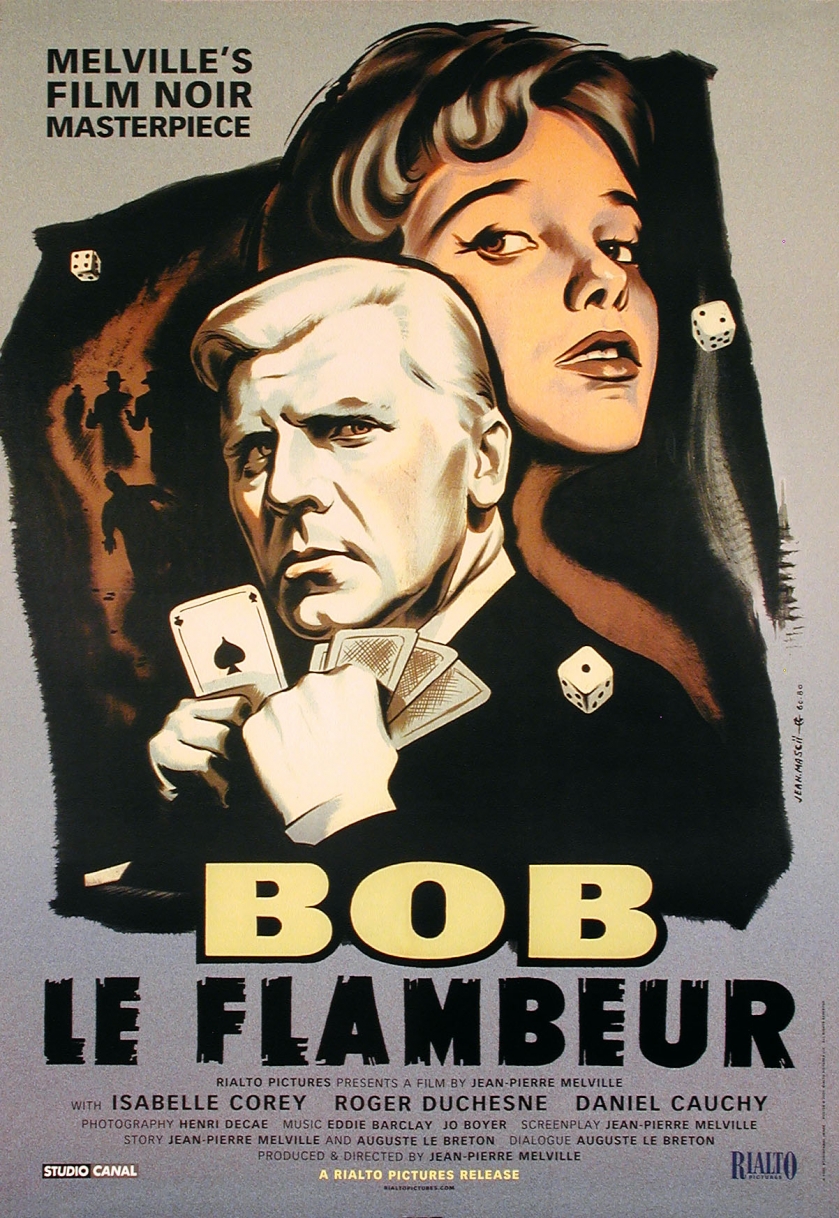
Bob le Flambeur


1956 crime drama

Rating: 16/20

Plot: A respected but down-on-his-luck gambler considers a drastic move to change his luck.

Everything in this movie, one that is cool as cool can be, exists in the in-between. It opens in a gray, silent time between dusk and dawn. The place is described as being between heaven and hell. There's a gap existing between Bob and his mentee and the female drifter they befriend. Bob's straddling a line between barely getting by financially and not getting by at all, a man who is in a valley between what the viewer assumes are lucky streaks.

The majority of the narrative involves characters meticulously planning and practicing each step of this heist they're attempting to pull off. But since this is a movie that exists in the in-between, it's a heist in limbo. Sure, things happen at the end, but this movie very well could have ended with all of the characters involved in the planning of the heist looking at each other, deciding the whole thing is a terrible idea, shrugging their shoulders, and going on their separate ways. Bob is comfortable in the moments before the dawn of the heist. He's just too damn cool for the excitement, so my favorite parts of the movie show him pre-excitement when he's in his element.

I really like Roger Duchesne here, a guy who brings this effortless cool to the titular flambeur. I like how everybody in his circle has to know that he's not even all that great at flambeuring, but he's still treated like he's royalty. And I loved Isabelle Corey as the young drifter he invites into his abode, one complete with his own slot machine. He picks her up, it should be noted, because he's a gentleman, not because he's horny. I was surprised at just how much of her the camera picked up, especially since she had to have been 16 or 17 when this was filmed. But you know, it was France.

Nearly stealing the movie are a panting dog and a xylophone/vibes player, the latter who gets plenty of time on screen and really knows how to take advantage of the opportunity.

Favorite line of dialogue: "The lessons are expensive, and the pupils never learn."

Jane B. for Agnes V.


1988 biographical portrait

Rating: 15/20

Plot: A look at the singer/actress Jane Birkin.

This is the kind of biographical portrait that only Agnes Varda could assemble. Interview chunks, slice-of-life glimpses of the actress in her home or with her family, fantasy sequences, art tableau, and even Laurel and Hardy impressions create a mosaic that doesn't give you much factual information about Jane Birkin's life or career but succeeds in creating her as a human being and helps you understand her personality. The latter, as well as Varda's style in presenting this woman, is charming. At one point, one of them (Varda, who appears in this a handful of times, or Birkin) says, "We agreed the film would wander." Wander it does, in that typical way that Varda's documentaries tend to wander. As a documentary filmmaker, she's less interested in justifying beliefs she has or sharing her ideas with the world. Instead, she's interested in exploration to get a better understanding of how people and places function or even a better understanding of herself. Here, she explores Jane Birkin in ways that are just lovely. And no, I'm not talking about scenes in which Birkin appears on screen sans clothing.

Speaking of that, there are a few surrealistic touches in some of these fantasy sequences, as well as some references to Dali and Magritte and these wonderful paintings I couldn't identify that were on the walls during a roulette wheel scene. My favorite scene shows that roulette wheel a second time, this time with the gamblers all nude and with a pair of naked guys on stilts for some reason.

Nipples on statues, a gloriously hopeless belly dance ("You're as sexy as a locust to them."), a wonderful use of a metronome, an eruption of flies on Venus, a story about puking carrots, a slow pan along the curves of a naked body. There's a lot to love about this one.

Oh, this directly references Kung Fu Master!, and it likely even helps clear up some of the themes of that movie.

Between Worlds


2018 Nicolas Cage movie

Rating: 8/20

Plot: A truck driver gets involved with a woman who can bring back the dead when she's being strangled. Or something. It doesn't make a lot of sense.

"I know that nothing has made any sense." A character said that, and it's as accurate as anything I can think to type about this movie. I don't even know what I want to say! Actually, I know one thing I want to say, so I'll type a "1" and then start a list and see where that takes us.

1) The first thing that needs to be mentioned might be my new favorite Nicolas Cage moment. The man's had his moments, but has he ever had a sex scene in which a partner asks him to read to her, a request he obliges by pulling out a book of poetry called "Memories" by Nicolas Cage and reading really bad poetry? No, he hasn't. An actor playing a character named Joe reading a book by the actor? That's the kind of thing that can demolish eighth walls in octagon-shaped rooms that only exist in your freakin' mind!

2) As a trucker with a mullet, the character Cage resembles most here is Cameron Poe from Con Air. However, he makes a reference to a woman's "peach juice" at one point which sounds more like Castor "I Can Eat a Peach for Hours" Troy from Face/Off. According to extensive notes I've taken on the subject, there are also peach references in Wild at Heart (he's offered one), Zandalee (he offers to share one with Judge Reinhold), Rage ("She's a peach."), and probably Windtalkers, a movie I've not seen.

3) I've decided that Nicolas Cage, likely because he's the kind of actor people are just dying to work with, gets carte blanche with his lines. For the longest time, I've assumed that screenwriters have just been good at giving him Nicolas Cage things to say, but now I'm thinking the stuff that comes out of his craziest characters' mouths have to come from the depths of Cage's own soul. How else do you explain the following:

"I'm gonna drain the main vein." That's a reference to urination, naturally.
"Does the tin man have a sheet metal cock?" That's a "Does a bear poop in the woods?" type of rhetorical question.
"Hold me, baby. Hold daddy tight." That's. . .I don't know what this is exactly. He says it while sneaking a swig of somebody else's medicine though, and the woman he says it to seems to roll her eyes after the line.
"Next time, why don't you wrestle a mangator." Anyway, I think that's what he said. You know, because "Why don't you pick on someone your own size?" or "Why don't you fight a man?" would have been too normal. We have to get "mangator" in there.

4) I would like to talk about the music. I don't know how much Angelo Badalamenti did, but I know he did the opening theme. That's pretty good actually, a haunting introduction to the supernatural shenanigans about to take place. The rest of the score is just awful, and there's way too much of it.

5) Two musical bits really stand out--one is the use of a Marilyn Manson song which, combined with the Badalamenti use, made me wonder if director Maria Pulera wants to be the next David Lynch or something. The other was the use of "Leader of the Pack" which baffled me. I can't reveal what was going on when that song came on, but it was during a "big" moment in the narrative, and "Leader of the Pack" didn't connect at all. I kept thinking there was some irony I was missing, but I don't think that was the case either. It was just baffling.

6) It was a stuffed bunny in Con Air. In this, the toy prop Cage gets to hold like it's a skull in Hamlet and act his mullet off with is a jack-in-the-box. During a moment when he holds it and weeps, I wept right along with him.

7) He also has a bitchin' shirt in this, one with a big alligator head on it. Or maybe it's a crocodile head. As people who have read the quality content I create here know, I don't know the difference between an alligator and a crocodile. But I know a bitchin' shirt when I see one!

8) If I had to pick a second-favorite character, it's probably the guy who tells Nicolas Cage that somebody is taking his truck. "Hey, Joe, they're taking your truck" guy. Or maybe it's "Rick" played by Hopper Penn, one of Sean Penn's kids. Rick is one of the daughter's stoner friends who I think might be around for comic relief. "I mean, I know we suck. . ." I'm not sure because large chunks of this movie seem to be comic relief.

9) The worst acting is done by Franka Potente. At times, she has a German accent, sounding a little like a female Tommy Wiseau. At other times, the accents not there. There is a random reference to her coming from Germany that I think had to be included after the filmmakers realized that it sounds like she has an accent at different points in the movie.

10) Maybe that accent is why Cage's character seems perpetually confused throughout this movie. At one point, his character was pretending (I think?) to not remember how to have sex (I think?), saying, "I don't even remember how to have sex. Sex?" And by that point, I've seen the character look entirely confused about everything else, so I just wasn't sure. Of course, a really intense sex scene with a lot of animalistic grunting occurred directly after that, so I guess he figured it out.

11) I recently made a list of my favorite films from 1973, and I bumped The Exorcist a few notches higher on that list. The reason was because I had just watched this movie, and Cage, during one of the sex scenes, asks the woman he's banging to say "Fuck me" like Linda Blair in that movie. I'm sure this is another case where Cage got to improvise.

12) This movie might contain Nicolas Cage's worst line delivery in his entire career. "You'd never hurt her." I think he might be holding the jack-in-the-box when he says that one.

13) "Golden shower!" If you've seen this movie, that might make you laugh.

14) Here's a conversation from this movie that I think I've actually had at some point in my life:

"Put your fucking pants on! You're gross!"
"Well, I don't know what makes you says that."

Speaking of this scene, it makes two movies from 2018 where Nicolas Cage gets to do his thing while wearing a ridiculous shirt and his underpants.

15) "Co-ouch!" I'm not going to criticize this one because it's really clever.

16) People who know me know that I love when Nicolas Cage points in exaggerated ways. That point has seemed to evolve into something else in this movie--a weird, gnarled hand gesture that looks like the bastard spawn of the Nicolas Cage point. I loved it!

17) Another hand gesture--this movie (which is poorly edited, by the way) has a bit of dialogue where Cage's character is talking about his dead daughter. He says, "She was five" and holds up his hand and all five fingers as a visual aid. And then the editing shows him raising his hand and showing five fingers a second time. I don't think I was supposed to start laughing at that point, but I did.

18) I don't know which was worse in this movie--the camera work or the pointless flashback that ended the movie.

19) I'm placing this movie--without doing any actual thinking about this--in my top ten Nicolas Cage performances. Between this, that scene in the bathroom in Mandy, and the pool table demolition in Mom and Dad, this is an actor at the peak of his powers. We are in the middle of a golden age of Nicolas Cage, my friends.

20) Ok, that's all I've got.

Kung Fu Master!


1988 drama

Rating: 15/20

Plot: Approaching middle age, a mother of two falls for a 14-year-old classmate of one of her daughters and probably crosses a few lines.

An Agnes Varda movie called Kung Fu Master!, complete with that exclamation point at the end of the title, always intrigued me, and her recent death gave me the excuse I needed to finally check it out. The story--one involving a middle-aged Jane Birkin having a romantic relationship (and possibly a physical one) with a 14-year-old played by Varda's son--should be more challenging than it winds up being on screen which is a testament to the empathy Varda has for her characters and the tender way this story unfolds on the screen. You never feel that the protagonist is doing the right thing here, but you don't quite think of Birkin's character as a villain either. And you deeply understand what this character's feeling, mostly from the way Varda chooses to shoot her although some inner monologue is shared in voice over.

The movie is called Le Petit Amour in the U.S., and that's really odd for two reasons. First, it's called Kung Fu Master! everywhere else, so you'd think in America, a country where some variation of English is spoken, you'd get an English title instead of a French one. Second, Kung Fu Master! is the best title ever, and calling it something else just seems like a terrible decision.

The title is from a video game that I remember playing on the Nintendo. The movie opens in the goofiest way possible with a kid walking down the sidewalk while practicing kung-fu moves, moves accompanied by video game sound effects. There are quite a few shots where Varda just shows us this kid playing the video game. And then there are shots of Birkin watching the kid as he plays the video game, and again, what should be creepy somehow manages to be touching. Maybe if it wasn't French, I'd be appalled.

Eggs are apparently a turn-on in this, and there's a puzzling moment where a trio of characters are imitating birds. And there are lots of references to AIDS and condoms, enough to convince me that there was a thematic link to that particular 1980's fear.

Anyway, I'm sad about Varda's death, mostly because she had enough life in her to make it seem like two people died instead of just one. I watched her other movie with Birkin from 1988 (Jane B. for Agnes V.) which I'll write about in a bit.

Did You Wonder Who Fired the Gun?


2017 documentary

Rating: 12/20

Plot: The filmmaker explores some family history, specifically his grandfather's murder of a black man.

An important and unfortunately timeless subject is addressed in this personal exploration, but the style made me feel like I was watching an audiobook. About 25% of this movie is a reddened shot of somebody driving down a road. Another 60% consists of still black and white shots. 10% of the movie is just shots of foliage. The rest of it is "ominous clacking" (that's what the closed captioning said multiple times), some backwards blues singing, a shot of a deer covered in flies, and a bunch of shots of trees. Oh, I already mentioned the trees, didn't I?

It's saturated in narration, so much that if there was any voice except for writer/director Travis Wilkerson in this thing, I can't remember any of them because of how much Travis Wilkerson was in there. Wilkerson tells us a lot while we look at those trees. He tells us all about talking to people, he reads us letters, and he tells us about what it's like to drive around. He doesn't explain what all the "ominous clacking" is about.

It's easy to appreciate what Wilkerson is trying to do here and his willingness to engage in an honest exploration of his family's history that I imagine would be painful and exhausting. It's a story of white privilege and racism and the stories of other human beings being cut short, and those are important to talk about. And that's exactly what Wilkerson does--talks and talks and talks. And shows us those trees.

Captain Marvel


2019 superhero movie

Rating: 9/20

Plot: Yet another superhero origin story.

This should anger feminists. After 73 Marvel superhero cartoons, a female character finally gets to be the protagonist in one of them. That's the good news. The bad news is that the movie is a terrible combination of vapid and derivative, and that main character is played by Brie Larson whose lack of charisma causes her to be upstaged by both a Samuel L. Jackson enhanced by special effects and a cat. Oh, and Ben Mendelsohn who is playing a character who could almost have been in Waititi's Thor movie.

Actually, before I really begin, I need to talk about the odd synchronicity with this movie and Us. What are the odds in 2019 that I'd see one movie in a theater, sneak into a second movie, and find out that both movies have shots of VHS copies of The Right Stuff?

If there's a decade worse than the 80's, it might be the 90's. This is filthy with cutesy clever references to that decade, and they didn't succeed in adding to the story or its central character or being funny. I guess I'm supposed to laugh at the appearance of antiquated businesses like Blockbuster or Radio Shack? Is a Nine Inch Nails shirt supposed to get me excited? Those cheap references--the cheapest of all being the use of a too-obvious song during a boring climactic fight scene--added to these Marvel Easter eggs bugged me. A frenemy of mine praised this while slamming the Han Solo movie and the Star Wars prequels for giving us information about C3PO or the origin of Han Solo's name, but Captain Marvel explaining why Fury has an eyepatch or showing us that stupid blue cube again and forcing me to try to remember what the hell that's all about or showing us why the Avengers are called the Avengers seem equally silly.

The female empowerment angle is clumsy, the action scenes are clunky and uninspiring, the sci-fi special effects are mostly ugly, and the disjointed narrative isn't nearly as clever as it thinks it is. This succeeds in a few scenes where Jackson and Larson are buddy-copping it up because their rapport is good, but for the most part, it's a major Marvel misstep heading into this next Avengers movie which I'm pretty sure is going to be hugely disappointing.