Oprah Movie Club Pick for May: North by Northwest
1959 thriller
Rating: 18/20
Plot: An advertising executive is mistaken for a CIA agent who doesn't even exist and has to traverse the country to find him and exculpate himself of a crime he didn't commit. He meets a blonde and nearly ruins his suit.
First, here's the location for the crop-dusting scene on Google Maps. I thought this was cool.
Hitchcock had a gift for creating thrills, but the thing that sticks out more for me in North by Northwest is the randiness and comedic touches. He and writer Ernest Lehman sauce things up with the arrival of the fetching Eva Marie Saint. The dialogue titillates, double entendres sparkle. Grant's suave and charming, the kind of dude who demonstrates a Hemingwayian "grace under pressure" when taking the time to flirt with a random broad while being chased by good guys and bad guys and chasing non-existent guys, but when you take a step back and look at him, he's not all that bright. Eve Kendell's a little too convenient, isn't she? The character might be great at playing the role, so seductive that his part nearly shifts, but why wouldn't a question like "Wait a second--why is she helping me?" ever cross his mind? I guess because his mind's in his trousers. I'm trying to place myself in Thornhill's loafers to decide whether I'd take the risk for a chance to have Eva Marie Saint fondle the back of my head, and I think I've ultimately decided that I would. She is, after all, a "big girl" "in all the right places," and there's just something about the little movements of her eyebrows, the way her fingers dance across Grant's ears, and the way she blows out a match that would be hard to resist. I know there are folks who would have liked to see another actress in this role, but Eva Marie Saint nails it for me, and I'd find it hard to believe that Cary Grant was without a boner in more than a few of these scenes. Love the way she says "I'm twenty-six and unmarried. Now you know everything." Their whole back-and-forth on the train is as stimulating as any modern sex scene, and they don't even "do it" (as the kids would say) on that first train ride. I know that because Hitchcock shows us an exterior shot of the train rumbling powerfully down the tracks while saving the phallic-symbol-entering-a-tunnel shot for the very end of the film. Randy!
Man, "using sex like some people use a flyswatter" is such a good line. He's got a few good lines. I like the one where he asks about which "subtle form of manslaughter" is going to be attempted next after they bad guys have tried to kill him by staging a drunk driving accident and hitting him with a plane. Not the most practical ways to end somebody's life. He also, exhibiting more of that grace under pressure, cracks jokes about real bullets and takes jabs at Eva. And he does it all like a true movie star, just exuding the kind of coolness that could make some men question their sexuality. They don't make movie stars like that anymore unless you'd put Clooney in that category. I also liked Landau's henchman character. There was just enough subtle suggestion to make you wonder about Leonard's sexuality and throw a submerged love triangle subplot in there. The camera just caught Landau's Leonard staring longingly at his boss too often. Speaking of Vandamm, I like how our first glimpse of him shows him playing croquet. And we learn later that he's not even playing croquet at his own house and maybe, unless he brought his own set along, playing with his own equipment. For whatever reason, that's funny. [Edit: My father tells me that it's Landau playing croquet. Are they both playing? It's not a game you're supposed to play by yourself.] The bad guys aren't exactly well-written characters, and there's little depth. They're just kind of there to throw Thornhill into different situations.
I hadn't seen this movie in a long time and remembered some of the effects being dated. I thought there was more green screen use, I guess. I'm not sure what I was thinking because the two big moments--the plane and Mt. Rushmore--look really good. Well, Mt. Rushmore looks as if it's a little too small, but I don't know for sure because I've never been there. But I did really believe the characters were climbing down the faces on that monument. That entire sequence seems like it would be too goofy to work, but I like what Hitchcock does with camera angles, and the suspense overshadows the absurdity of the whole thing. The crop-dusting scene takes place in Indiana, something that I was not aware of. That's appropriate because that kind of thing happens in Western Indiana all the time. That's a great scene, especially if you have seen the movie or looked at the poster and spotted the plane. Hitchcock uses time very well there and gets away with having Cary Grant just stand there looking at dirt for a lot longer that most people would think about having him stand there looking at dirt. The entire thing is shown sans music, and if you listen closely enough, you can hear the rumbling plane the whole time. Later, there's the great shot of Grant and the guy with the hat standing on opposite sides of the road just looking at each other and a great use of rustling corn. Great scene! The only effect that does look a little quaint is the drunken drive chase sequence. Grant's facial expressions don't help that scene much.
The whole movie isn't sans music, of course, and Bernard Herrmann's score is terrific. I love the boisterous opening music, stuff you're just not going to hear in movies anymore. They don't make movie stars and they don't do movie music like that anymore. There are times when Herrmann's score is a little too big maybe, but it punctuates perfectly most of the time, easily enhancing more than it gets in the way. His compositions always make driving seem more exciting than it does in other movies.
This also has one of my favorite Hitchcock cameos. He gets it out of the way early here. A tiny razor, uproarious elevator laughter, another mom character, a pair of stolen cabs, unintelligible dialogue at an airport, and, according to my father, a kid in a restaurant covering his ears. There's just a ton to love about this mistaken identity everyman adventure yarn!
Shane Reviews the Greatest Movies Ever Made: Vertigo
The Birds
1963 fowl movieRating: 17/20
Plot: This slut buys some love birds and makes the trek to Bodega Bay to hand-deliver them the guy she currently wants to sleep with. Suddenly, seagulls and crows begin to attack humans for no good reason. Oh, snap!
"Are the birds gonna eat us, Mommy?"
Again, Hitchcock does a lot of subtle things with the camera here that enhance the experiences and set this a few notches above your standard birds-attacking-people-for-no-good-reason movies. The Bodega Bay setting is often framed so perfectly, and there are a lot of interesting visual perspectives you're not used to seeing. I'm not sure if Hitchcock was trying to show you things from a bird's eye view or not, but it kept things naturally uneasy. I also like the decision to use no music at all in the movie, just those exaggerated, almost comic bird sound effects. I saw this one as a kid (I think at my dad's house) and some scenes just never leave the mind--the creepy school children song chanted while crows gather on the monkey bars, the shot of the dead farmer with his pecked-out eyes, the seagulls floating into the overhead shot of a fire in the middle of town, that horrifying Tippi-in-the-phone-booth scene. Speaking of Tippi, I'll still contend that the scene where she's attacked in the attic is the most erotic five minutes ever filmed. I also love the scene where a bird puppet attacks Rod Taylor's arm, and the Night of the Living Dead-esque drama that unfolds as the characters hide inside their boarded-up house. Another great Tippi shot: the quick cuts between a moving line of fire and Hedron's slightly-changed expressions as her eyes follow the flame's movement. And who wouldn't enjoy watching so much footage of birds attacking children? Seriously, what's better than that? Speaking of that, I could understand an argument that the special effects in this are dated, but I really love them. They're dated in a good way! This movie also has a great stunt when a guy pumping gas gets hit in the head with a bird and falls down. The final shot--the car driving off with the lower half of the screen covered in bird and the upper half a gray sky with sun rays slicing across--is also really beautiful. There's an interesting subtext that takes this out of B-movie realms with poor Mitch and the women in his life--the old flame, the feisty aggressive new fling, the oppressive mother, and the little sister (what an age difference!). It'd be fun to look at the birds as symbols or examine this movie from a feminist perspective, but I'll save those kinds of thoughts for the next Disney cartoon I watch.
[Too Much Information Alert!]: The first time I pleasured myself, it was while watching that birds-attacking-Tippi scene. That wasn't at my dad's house. He showed me that when I was three, too young to masturbate. Speaking of toddlers, I tricked Sophie into watching this with me by telling her it was Rio. She didn't seem to enjoy it very much.
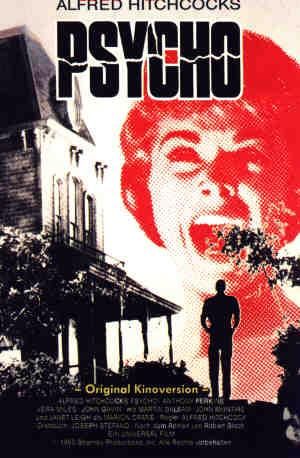
Psycho
1960 motel movieRating: 18/20 (Jen: 17/20)
Plot: The new highway's made the Bates Motel a little out-of-the-way, and Norman and his mother try to keep the business afloat. A gal who's just stolen a bunch of money finds her way to the little secluded motel, decides to take a quick shower, and ends up (spoiler alert!) losing all her chocolate syrup!
The IMDB trivia page for this one has a few fun nuggets. Randy ol' Alfred referred to Perkins as "Master Bates" throughout the production. And this is the first ever movie to show a flushing toilet. Oh, and Marion's white car (lots of black and white symbolism in this movie) is the Cleavers' car on Leave It to Beaver.
Well, Jennifer had not seen this movie. Not only that--she had no idea what happened in it. I was a little envious actually. I remember when my father showed me this when I was three. The iconic house, the quick edits during that so-complex shower scene, the shocking ending. I want to see all that for the first time, too! This rolls along like a B-movie directed by an auteur, and its brilliance is really in the chances that Uncle Alfred takes with the story and the breaking of movie conventions. Killing the lead actress off halfway through the movie? C'mon. You're just not supposed to do that. The psychotic mother/relationship that would make Oedipus cringe and Freud demand to be helped out of his underpants? No wonder Walt Disney refused to let Hitchcock film on Disney property because of this "disgusting movie"! Herrman's score is among the best, right up there with Jaws when you're talking about most recognizable and duplicated scores of all time. Unlike some of my favorite Hitchcock movies, this one doesn't get better each time you watch it. It's not without flaws, and without the surprises, it's just not as much fun. You unfortunately can't watch this for the first time more than once. But with its iconic imagery, that incredible score, one of the creepiest villains in movie history, almost overwhelming suspense, and a nipple that I might have only imagined, this is still something that you'll never forget.
Having said that, when I asked Jen for her rating, she at first said, "Psycho? I don't remember it."
Urine Couch Movie Club: Rope
1948 rope movieRating: 18/20
Plot: Brandon and Philip (possibly gay) strangle one of their peers with the titular murder weapon and then hide his body in a trunk while throwing a dinner party. Their old teacher Jimmy Stewart starts to get suspicious after one of them yells, "You're quite a good chicken strangler!"
That's such a great scene. The camera moves like on a metronome, bouncing from speaker to speaker. Actually the camera work in this thing is virtuosic and, for me at least, is at least half of the fun. What I love: Brandon (played by Orel Hershiser, I think) post-murder, his expression of unhinged contentment and the way he smokes his cigarette; the kitchen door swinging to reveal the rope dropped into a drawer; the opening of the curtain for the first super-crisp view of the city; the long shot of silent Jimmy at the tail end of that ridiculous chicken story; the camera movements during the "How would you kill David?" scene; the room filling with red neon at the end. Rope, with Hitchcock trying to trick us into thinking it's all a single shot, could have been as stiff as a staged play, but that camera movement and character choreography is so much fun. The Dostoevskian, nihilistic lead characters and their little game fascinate, and there's a lot of humor buried in the script if you look for it. The landlady's arrival, the "knock 'em dead" and "Why can't he keep his hands off people?" lines. As I recall, Hitchcock didn't like Jimmy's performance in this movie and Jimmy didn't like the movie at all. They're both wrong because Stewart is quietly great in this role (I really like watching him think in this movie) and it's definitely in the upper-echelon of Uncle Alfred's flicks.
Urine Couch note: I ended up giving a guy and his whore a room for 25 bucks because I could tell he was going to argue with me and make me miss more of this movie than I wanted to. My manager wasn't too happy about that.
Urine Couch AM Movie Club: Frenzy
1972 shocking masterpieceRating: 17/20
Plot: Oh, snap! London's got itself a Jack the Strangler who sexually violates his female victims before tie-ing them in the necks until their tongues hang lifelessly out. Since poor Richard stumbled into an Alfred Hitchcock movie, he's mistakenly suspected by the po-po after his ex-wife winds up dead. He's all like, "Whatever, man. I didn't do nothing!" and tries to find the real killer like the guy searching for the one-armed man or O.J. Simpson to prove his innocence.
I like working Monday mornings at the motel because one of the channels I get for the Urine Couch AM Movie Club shows a Hitchcock movie. The one before this was The Birds, one of the most erotic movies ever made in my opinion, but I missed it because I got the dates mixed up. Like a lot of Uncle Alfred's later films, this one seems a little dated. It just looks like a product of the 1970s to me. But although it's not quite a masterpiece, it's a tense thriller with some great moments that nobody but Hitchcock, here at his surliest and randiest, could provide, most famously in a great long shot that walks the viewer backwards out of the scene of a crime and into the street. Unlike a previous scene, this one spares us the brutality, but the shot might be even more chilling because of it. Just masterful stuff. That earlier scene is especially brutal, the camera lingering on the violence before ending with an almost clownish shot of the victim with her tongue hanging out like a child pretending she's just been strangled. Another great scene involves the murderer hiding in a potato truck. Like most of Uncle Alfred's work, he offers a generous helping of dark humor with the moody violence, so there's this odd blend of grim and comical that I really liked. And the perverse old man threw in some nudity as well! I liked the cast a lot, more probably because I didn't recognize any of them, and the finale, with one hell of an final line, rivals my favorite Hitchcockian endings. This is a well-written, edgy thriller that works as a final semi-masterpiece. It's also got a lot of really ugly English people in it. Do they all look like that?
Lifeboat
1944 Hitchcock movieRating: 16/20
Plot: A black guy, a nerdy guy, a guy who likes dancing, a guy who doesn't like to wear a shirt, a snobbish socialite, a young woman, and maybe a couple people I've forgotten about survive the sinking of their ship. Tension mounts when they pick up one of the Germans who torpedoed their ship. They debate what to do with their "prisoner" but soon realize they may have to rely on his expertise to save them from their predicament.
I was skimming a trivia page for Lifeboat and came across this nugget: Members of the crew noticed that Tallulah Bankhead was performing sans underwear and brought the issue to Uncle Alfred's attention. Hitchcock answered, probably while chewing on marbles, "I don't know if this is a matter for the costume department, makeup, or hairdressing." I told my wife this, and she asked (with that scrunched-up face she makes some times), "Are you putting that in the blog?" I said, "Of course!" She suggested I start writing cleaner and "get rid of the randiness." So that brings us to the first shane-movies poll of 2011! Please leave your answer(s) in the comments. Do you:
A) want less randiness
B) want a lot less randiness
C) want more randiness
D) want a whole lot more randiness, randiness of Mary Poppins proportions!
E) want nothing but randiness
F) want no randiness at all
G) want the exact same amount of randiness
H) want the same amount of randiness but desire some diversity in the randiness
I) have no problems with randiness as long as it's not too gross or read too close to dinner time
J) have problems even remembering any shane-movies randiness in previous entries
K) have no problem with randiness as long as it's in an entry about randy old Uncle Alfred's movies
L) just want me to write about the movies and not go on and on about randiness
M) want this to be the randiest blog in the history of the Internet
N) think I should start having give-aways like some blogs my wife reads
Quick note: Two movies in a row to start this year with a compound word for a title. Although I'm not sure Timecrimes is a real word.
The movie? Well, John Steinbeck wrote it, based on Hitchcock's idea, and Hitchcock directed it. For a 40's movie that takes place entirely in a boat (Hitchcock experimenting again with a one-setting movie), it sure manages to seem realistic. I like that Hitchcock wasn't afraid to take a tense situation and throw in some comic moments. There are a lot of characters for one lifeboat, and I wish they could have been developed more. This is the type of movie that forces the viewer to put themselves in the situation of its characters and imagine making the same choices though, and it is a story more about the situation than the individuals involved. I really liked Walter Slezak as the enigmatic German, always calculating and with motivations that don't entirely make sense to me. Odd ending, one that made me wonder if Hitchcock was messing with me. Speaking of the director, you've got to look close for his trademark cameo, but it's a clever one.
The Man Who Knew Too Much
1956 movieRating: 14/20 (Cory: 14/20; Dylan: 3/20)
Plot: Following a medical conference, Indianapolis doctor Ben McKenna decides to explore Morocco with his wife Jo and their son Hank. Bad idea since Morocco is apparently the most dangerous place on earth! After befriending a mysterious Frenchman on their bus, a series of events occur that lead to poor Hank being kidnapped and taken to London. Dr. McKenna knows too much, but he isn't allowed to reveal anything as he and Jo zip on over to London to look for Hank, even though Hank is sort of obnoxious.
This is not one of Alfred Hitchcock's better efforts. It's colorful and the textures of both people-packed Morocco and nearly-vacant London add to the film. I like Doris Day even when she's singing the seemingly endless "Que Sera Sera," and I like about half of what Jimmy Stewart is doing. But there are more than a few of those moments of Jimmy Stewart awkwardness, like in a very exciting scene where his character has trouble eating. I really like Reggie Nalder, the guy who plays the assassin, looking like the kind of guy who should be a villain in a James Bond movie. The story is good here, and the building up of suspense in a climactic scene at the Albert Hall is very well done. Unfortunately, this movie is way too long, gets really goofy, and has a sort of second ending that really takes away most of the wallop that the Albert Hall scene delivered. It's a second ending that is way too long on its own, but it's also completely preposterous. Oh, and then there's a third ending which is a silly joke. It all leaves a bad taste in my mouth and nearly makes me forget the positives about The Man Who Knew Too Much. One positive I didn't mention is a scene in a taxidermy shop. That scene was easily the best of the film, and it has very little to do with the story. It's probably not a good thing when a red herring is the best thing about the movie.
This was actually a historic occasion, marking the first time I've watched a movie with blog-reader Cory. Jimmy Stewart is his favorite actor, but look at that poster up there. The guy can't even act on a poster!
The Wrong Man
1956 Hitchcock movieRating: 15/20 (Jen: 15/20)
Plot: The Right Man has been flying around the neighborhood committing armed robbery. The Wrong Man, jazz bassist Manny Balestrero, looks a lot like The Right Man, and is mistakenly identified as The Right Man even though he's actually The Wrong Man. He's arrested for the crimes, and he and his wife, The Wrong Man's Right Wife, have to find an alibi to prove The Wrong Man's innocence.
Ah, Hitchcock, you're a tricky one. After he gets his shadowy cameo out of the way early, he gives us a scene with our protagonist walking out of the Stork Club, his place of employment, and down a sidewalk while flanked by a couple coppers. It's a wonderful bit of visual foreshadowing. There are a bunch of shots I really like in this one. Hitchcock gives this "true [suspense] story" a noir flavo[u]r, and the way the city and its shadows are filmed perfectly complements poor Manny's bewilderment and fears. The cinematography is simple and almost frill-free but it's effective. I really like a scene after Fonda moves into his jail cell and the camera follows him through the tiny rectangular hole in the door. I also think a scene in the courtroom where Fonda's character looks around and notices that nobody is paying attention is really good. This is far from a Hitchockian masterpiece though. Whether it actually happened that way or not, I really dislike the wife-goes-crazy subplot. I just didn't buy that whole thing. I also thought parts of the story were a bit rushed, causing it to lose a little of the effect. And there are a few scenes with children that are just brutal, especially one involving a couple girls announcing that the previous owner of an apartment has died and then laughing hysterically. And back to Hitchcock's trickiness: Is The Right Man seen in this movie before the big revelation at the end? That'd be cute, Alfred. Real cute.
Robyn Hitchcock: I Often Dream of Trains
2009 concert filmRating: 14/20
Plot: Cult artist Robyn Hitchcock reflects on his 1984 solo album I Often Dream of Trains and performs the album (with a few extras) with some pals.
I just did some math. I've been listening to this guy for over half my life. He's one-third of Shane's Holy Trinity of Musical Peoples. I like all of his albums at least partially and a lot of them I love and a few of them I'm obsessive about and will always listen to. This is one of the latter, so it's cool to see him introspect on the times when the songs blossomed and the 25 intervening years since. Some of the songs (the title track, "Uncorrected Personality Traits," "My Favourite Buildings") are performance staples anyway, but a few probably hadn't been performed live in a long time. There's some of his typical between-song banter, largely improvised but with some that are obviously a little more written, but the focus is mostly on the songs with sparse instrumentation (piano, one or two guitars, the occasional trumpet or shaker) played in a quiet atmosphere. Interview snippets from, appropriately, a train add a bit of background on some of the songs although it's more likely that some of Hitchcock's descriptions will confuse more than enlighten. I really like how the main bulk of the concert was bookended by "I Often Dream of Trains" as a low-budget early-eighties video and then again in the live setting with more visuals from the video contrasting Hitchcock now and Hitchcock then. The whole thing is a lot looser than Demme's Storefront Hitchcock movie even though the song and visual variety add a little something extra to that one. My only gripe is that the show should have ended with the final haunting notes of the title track. Instead, Hitchcock flees the stage, exchanges his polka-dotted shirt for a flowery one, and performs an encore made up of recent songs. The encore was extraneous. Oh, and I guess I can gripe that not every song from Trains made the cut. The acapella "Furry Green Atom Ball" is definitely one I would have loved to see. A must for Hitchcock fans.
This is on Sundance a couple few more times this month. Catch the fever!
The Lady Vanishes
1938 black comedy/mysteryRachel Getting Married
2008 dramaRating: 11/20 (Jen: 13/20)
Plot: Kym (this movie lost a point just for this spelling) is released from a rehabilitation center to participate in her sister's wedding with her dysfunctional family. Drama unfolds.
I can't figure out if Shane Getting Annoyed or Shane Getting Uncomfortable would be a better alternate title for this movie. First off, Anne Hathaway's performance is really inconsistent. At times, she's terrific and makes it easy to become emotionally involved in her character. At other times, she's shaky, almost confused by her character. Speaking of shaky, this is filmed in that faux-documentary style with handheld cameras, and that gets old really quickly. There are some extraordinarily awkward scenes in this that go on far too long--endless toasts at a wedding rehearsal dinner, some sort of variety show, a weird scene involving an impromptu dishwashing competition, and a reception that seemed twice as long as any reception I've ever been to. That reception, by the way, included the only reason I wanted to see this movie in the first place as Robyn Hitchcock plays a wedding singer and performs a couple songs. He's juxtaposed with an annoying rapper though which perfectly illustrates what's wrong with this movie. There's some good, maybe even some great, butting violently up against the bad in a way that makes this ultimately clunky and unsatisfying.
Robyn Hitchcock: Sex, Food, Death. . .and Insects
2007 documentaryRear Window
1954 thrillerRating: 19/20 (Jen: 17/20)
Plot: A magazine photographer named Jimmy Stewart is cooped up in his apartment because he broke his leg jumping off a bridge to save an angel in another movie. With lots of time on his hands and nothing else to do, he sits in his wheelchair and spies on the neighbors across the courtyard. He also tries to figure out whether his girlfriend, a stylish socialite, is somebody he should marry. With one week to go before the cast comes off, he notices one neighbor acting very suspiciously and begins to suspect that there's been foul play. He gets help from his girlfriend, his nurse, and a detective pal.
Is there another movie where we get to see Jimmy Stewart's nipples? My favorite things about this movie--Miss Torso and the cigarette burning in darkness of Thorwald's apartment. My least favorite things about this movie--the flashbulb thing at the end and the fact that Jimmy Stewart's nipples are only displayed twice. I really like how the little stories in each of the windows unfold and how each seems to represent a different part of the protagonist's psyche--lust, fear, desires, creativity, hunger. I'll have to think about that more, but those little stories seem to characterize Stewart's character as much as his actions and words do. One of Hitchcock's best.
Maybe I should change the name of this blog from 365 Movies to Jimmy Stewart's Nipples.
Strangers on a Train
1951 comedy thriller The Pink Floyd and Syd Barrett Story
2003 documentary