The Night Strangler


1973 television movie sequel

Rating: 14/20

Plot: Following the vampire shenanigans in Las Vegas, disgraced reporter Carl Kolchak moves to Seattle and becomes involved in another wacky, possibly-supernatural murder mystery.

There are two things I failed to mention when writing about this movie's predecessor--The Night Stalker. First, I really dig the music. It's by Bob Cobert, and it really helps the action move in these things. Second, I really like Kolchak's wardrobe. That hat is enough to make him stand out all on its own, but his collection of suits are also perfect for this character. I can't pretend I'm an expert in men's fashion from the year I was born, but it seems like McGavin's just a little out of style here.

Speaking of McGavin, he gets more opportunities to scream at people in this one, and that probably enhances the experience. The conflict between law enforcement and journalism intensifies in this one, and if there had been a third movie, I imagine it would have involved McGavin biting somebody's face off. Maybe he does in the television series. I should watch that and find out.

McGavin is on top of things here, a few steps ahead of everybody else. Or at least a few steps ahead of where everybody would like to admit they are. He's sans his Las Vegas connections--the one he can get info from in exchange from a Whitman's sampler--and is forced to find new friends to work with. There's a lovely belly dancer played by Jo Ann Pflug. She's best, it should be noted, when she's belly dancing, her hips moving "just as fast as her mouth." The image almost makes me want to say something about how I wouldn't mind an opportunity to pflug her, but that doesn't sound like something I'd ever type. Other friends include Wally Cox, Margaret Hamilton, and Al Lewis as the "guardian of the secrets of Seattle buried in the morgue of the Daily Chronicle," a professor, and a tipsy underground dweller. Add in John Carradine, and you've got quite a fun cast here!

My two favorite characters: Joe Roberts, a guy singing "Blue Heaven," poorly; and Wilma Krankheimer, a character who scowls at McGavin as a kind of running gag.

There's some goofiness here (the killer screaming "Ahhh!" every time he attacks, a climax that is a little too convenient), but it's hard to complain about all that because this is fun little movie. The usage of Underground Seattle was inspired. That was really cool to see.

The Night Stalker


1972 television vampire movie

Rating: 14/20

Plot: A reporter tries to get to the bottom of a series of Las Vegas murders.

This is long overdue as it's a movie that Cory really loves. I'm currently working on a "Best of 1973" list and noticed that the sequel--The Night Strangler--is on Cory's top-ten list. The Night Stalker is on his 1972 list, and I've known he's liked these for a while but have never gotten around to watching them.

It's got a little more grit than what you'd normally expect from a made-for-television movie, and that's likely because it's got the stink of the 1970s all over it. With a script by the great Richard Matheson, a good story can at least be expected. This delivers, maybe not because of how interesting or original the plot is but how much wit is in the storytelling. A lot of the appeal is Darren McGavin in the lead performance as a the protagonist, a sort of anti-hero reporter named Carl Kolchak. More than any character in recent memory, this is one I wouldn't mind sitting down and having a few drinks with. He's got to cool hat, and McGavin also brings this brand of cool to the screen, almost in this effortless way. He's fun to watch when he's a step or two ahead of the other characters, when he's at odds with the other characters, when he's lost patience with the other characters, when he's smooth-talking other characters, when he's celebrating some minor victory, or when he's beleaguered. I can even put up with large chunks of this being narrated, especially since he's saying cool noirish things like "Cheryl Hughes. . .on route to her doom." He's just great, and I imagine a lot of the appeal of this for Cory is McGavin's performance.

The action scenes are a little goofballish, but the Whitman's sampler product placement and the realization that hospitals just keep bottles of blood in refrigerators made up for that. I also liked a used car salesman played by Stanley Adams. Add in just the right amount of style, including some sly camera work in a climactic sequence when McGavin is exploring a house, and you've got a television movie definitely worth checking out.

If Beale Street Could Talk


2018 movie that is not a Best Picture nominee

Rating: 16/20

Plot: 22-year-old Fonny has knocked up 19-year-old girlfriend Tish. When he's arrested for a crime he didn't commit, their families have to deal with it.

I've mentioned the guy who works across the hall from me, a black man who I desperately want to fool into thinking I'm cooler than I am. So far, it's not worked very well although he does laugh at my jokes. He's got the best laugh. Anyway, a couple of months ago, we were talking about movies and both picked what we thought had a chance to win Best Picture at the Academy Awards. His pick was either Boy Erased or the other one with Steve Carell, something I think is called Boy Inebriated or something like that. I haven't seen either one of those and don't really plan on it. My pick was one I felt was almost cheating--picking a follow-up to Best Picture winner Moonlight. Or did La La Land win that year? I can never keep that straight. My pick wasn't even nominated, and even though I hadn't gotten around to seeing it yet, I was surprised. Now that I've actually seen it, I'm even more surprised.

Barry Jenkins is a maestro, and in this James Baldwin adaptation, he's conducting a smooth jazz that just hits all my sweet spots. He weaves together the characters' presents with flashbacks outlining a budding and very believable romance, and he does it in a way that brings out a variety of emotions. During those flashbacks where we see Tish and Fonny in various stages of their budding romance, you just feel that love. It bleeds through the screen. You fall in love with the way these characters have fallen in love with each other--the way she looks at him, the way he longs for her, the way they have sex, the way he is so gentle with her when they're getting ready to have sex, the way they struggle, the way they celebrate together, the way they just become one on the screen. And that makes it more devastating when they're separated by a sheet of glass. Jenkins gives us imagery and performances that are capable of filling the audience with joy, of making the audience angry at injustices both big and small, of making the audience as anxious as Regina King's character as she readies herself with make-up and a wig in front of a mirror, of shocking us with the lack of empathy a character can have for another because of ingrained religious beliefs. It's just a movie that makes you feel. You feel it more than you watch it, and it sits with you for hours and hours after the credits have rolled.

Jenkins does a lot with color here, and the camera work, while rarely flashy, always seems to be just exactly where it's supposed to be for as long as it needs to be there. Just as important to the visuals, however, is the score. It's a gorgeous one, fragile echoing horns and yearning strings. The score is from Nicholas Britell, the same guy who did Moonlight.

The ensemble cast is great, nearly perfect individual melodies weaving in and out of the narratives. Kiki Layne and Stephan James are entirely believable, but their romance is also one that seems less like a movie and more like a dream you've stumbled into or some sort of fairy tale. Brian Tyree Henry pops into this for about ten minutes and hits every note so well in a scene that's a roller coaster of subtle emotional shifts that you might wind up believing he is the best actor on the planet. Regina King really is as good as advertised, and without reminding myself who else is up for the Best Supporting Actress award, I'll say that she's definitely deserving. I like the two fathers played by Colman Domingo and Michael Beach, too. They all collaborate so well with Jenkins, sharing secrets with the audience through both their dialogue and through all sorts of things that aren't said at all. Just lovely performances.

So many standout scenes. I think I was hooked from the get-go with one of the fancier shots and the accompanying music. A scene where the two families get together so that one can share the news of the pregnancy is another stand-out, including a pair of moments that actually made me laugh out loud. So much smoke during a more ostentatious scene spiraling around a character's artwork, all the complimentary colors, a scene with imaginary appliances in a future apartment, a celebration in the middle of a dreamlike street, smashed tomatoes on a brick wall, a scene on a subway preceding a sex scene, that sex scene and a brief shot of a record playing, Stephan James stripping to his underpants, the aforementioned scene with Regina King and a mirror, the scene with Brian Tyree Henry.

I've given both Moonlight and this a 16/20, and I'm wondering if I'd raise those scores if I saw them again. Maybe I'll give Moonlight another viewing soon.

Again, I can't believe that this wasn't nominated for Best Picture over A Star Is Born, Black Panther, and Bohemian Rhapsody. It just doesn't make any sense.

Bohemian Rhapsody


2018 Best Picture nominee

Rating: 12/20

Plot: The story of Queen, a band.

A meta gag, a little too cheap for my tastes, featuring a reference to Wayne's World didn't help me realize that it was an unrecognizable Mike Myers in the scene. I believe that means I'm some sort of moron, and any movie responsible for convincing me that I'm a moron can't be worthy of a Best Picture nomination.

This covers too much territory, a shallow look at the Queen story. It nudges up against a lot, sweats on all of it a little bit, and barely pauses to let the viewer catch his breath. It's a Queen's greatest hits musical biopic. The high points make it worth watching--the recording studio stuff where the group is experimenting in the early days or recording "Bohemian Rhapsody," the performances (including the climactic Live Aid concert), the part where Mercury compares his throat to a vulture's crotch. The music stuff is fantastic even when the editing isn't, but when there's not music going on, the movie's a little generic and a little poorly written. Narrative liberties were taken, but that didn't bother me as much as the cheap Wayne's World gag, something that should have been a part of a deleted scene.

Is Rami Malek good? Like the rest of the movie, his performance is good when there's music involved and not so good when it isn't. The teeth are distracting, and I'm not sure I was supposed to laugh when he told a character that he was born with four more incisors than a normal human being. Malek has the moves and mannerisms and mustache down, and whatever movie magic is responsible to blend his voice with Mercury's and some Canadian's voice worked really well.

Live and Let Die


1973 Bond movie

Rating: 12/20

Plot: Bond tries to bust up an evil mastermind's plan to get everybody hooked on heroin.

Roger Moore came in silly guns a'blazin' in this, his first movie as James Bond. This isn't as effective as the equally-silly follow-up, The Man with the Golden Gun, likely because there's no Herve Villechaize. As silly as some of these Bond movies (especially the Moore ones) can be, this one still somehow manages to stand out like something that almost feels like a parody. Before the credits and that Paul McCartney song, there are three murders involving irritating sounds, a fake-looking snake, and a dixieland casket. Along the way, you get henchman with intimidating metallic arms, (a guy named Tee Hee, naturally) James Bond escaping from a predicament by jumping on crocodiles' heads like he's the character in Atari's Pitfall, a chase with an airplane where the plane never leaves the ground, a boat chase, a sheriff character (Clifton James' J.W. Peppers, not doing anything here which would make you think he should be in the follow-up as well) who seems straight out of a Smokey and the Bandit rip-off, virginal Tarot card readings, voodoo dancers, all sorts of mystical shit, a shark, a double-decker bus, a musical number, death-by-compressed-gas-pellet, and a character named Whispers.

So it's kind of mindless fun. But there's an issue. This Bond film wants to piggybank off the popularity of blaxploitation, and it does so in a way that seems so backwards and dated 45 years later. In this movie, there are lots of black characters. The problem is that every single character--from the cab driver with those fantastic sideburns to Mr. Big and his henchmen to a whiny and screeching double agent--are all bad guys. Well, except one. There's one black character who's a good guy, but he doesn't really do much of anything and dies offscreen unceremoniously. But don't worry--we get to see a whole lot of black people shot, and Tee Hee, Whisper, and Mr. Big et. al. die spectacularly. It just didn't make me feel good to see a movie in which all the good guys are white people and all the bad guys are black. And don't get me started on any subtexts about black people being responsible for bringing drugs into communities or nonsense like that. The whole thing even managed to make the Bond movies' usual attitude toward women less palatable.

I did like Jane Seymour as Solitaire, the Bond girl in this one. Along with that Bond motif, the character also gets a gadget, a silly, overused magnetic watch. And he gets to go to exotic locales--like Harlem. And there are all sorts of delightfully bad punning quips. The character fits Roger Moore well. I always like him in these things.

I'd forever be thankful to this movie for having a character teach me about the difference between alligators and crocodiles, something my long-time blog readers know I've always had a problem with, but unfortunately, I've already forgotten the difference.

RBG


2018 biographical documentary

Rating: 14/20 (Jen: No rating, saying "You don't do your blog anymore, so I don't have to rate movies anymore.")

Plot: The life and career of Ruth Bader Ginsberg, second female on the Supreme Court and all-around badass.

My wife's one-word review--"light." This is fine, a pop-documentary that has just the right amount of breeze and inspiration. This checks all the boxes it's supposed to. Silly archival footage (Trump's favorite show Saturday Night Live, etc.), obvious music (Beethoven's 7th alert!), and interview snippets from Ginsberg's family members, folks she'd represented, and colleagues move this zippily along. It succeeded in making me want a t-shirt, and if that was the intent, I guess it was effective.

Honestly, the whole thing made me a little sick. No amount of shots showing me how RBG works out is going to convince me that she's outliving Trump's presidency, and that terrifies me.

Of Fathers and Sons


2017 (2018?) documentary

Rating: 16/20

Plot: A filmmaker gains the trust of a jihadist and spends time with him and his sons.

Director Talal Derki was born in Syria but moved away and now lives in Germany. He came back to Syria, posing as a war photographer, and befriended this jihadist and his family. Well, only the sons are shown--the wives are barely mentioned and never seen. He's a fanatic, even naming his oldest son after Bin Laden and praising his god for allowing one of his sons to be born on September 11th. Sure, he does have that familiar whistling ringtone, something that really threw me for a loop for some reason, but this guy's pretty serious about wanting to play a part in a World War III that will bring about end times. He's like a Syrian Mike Pence. He sings along with the music played on the contemporary Islam music station, he snipes, he hunts for mines to remove, and he encourages his sons to grow up to be terrorists because mamas might know not to let their babies grow up to be jihadists, but mamas don't really have much say in this society.

This is disturbing, really a tough watch, and I was tense nearly from start to finish. I figured the filmmaker survived the experience of filming this family, but there really are so many ways he could have died during this project. I'm not sure how many sons this guy has, but the film focuses on a couple of them. Obama is a goofy-looking dangerous kid who throws rocks at kids at the school he's stopped going to because education isn't something that's important to a child. He also picks fights with people and, in one scene, catches a bird that he winds up killing. The other kid is almost a foil, and I really don't want to give too much more away because it would probably diminish the impact of this thing.

Very strangely, a scene where characters are crying in this affected me.

Hale County This Morning This Evening


2018 Best Documentary nominee

Rating: 16/20

Plot: It doesn't really have one although there's a kid who wants to play basketball and a couple who have children in there.

Like a more experimental Frederick Wiseman with a little more patience, first-time filmmaker RaMell Ross spent five years in the titular county filming its inhabitants and seeing what stories unfold. The results is a very short but mesmerizingly intimate look at real people with real struggles. It's lovely and poetic, often hopeful and often sad. Ross finds everyday magic in insignificant moments, focusing on a lot of the spaces between the bigger moments in these human beings' lives. Using slow-motion and time-lapse stuff and having sounds bleed from scenes into subsequent scenes, Ross brings just the right amount of flash to this, never forgetting that his movie is about people. Odd title screens bring up questions:

What is the orbit of our dreaming?
How do we frame someone?
What happens when all the cotton is picked?
Whose child is this?
Where does time reside?

It's probably unnecessary and doesn't give the imagery as much context as it might seem. Instead, the viewer is forced to put together the pieces and find connections between the seemingly incongruous and often abstract images and scenes. References to a catfish plant and lots and lots of sports allusions help a little, as do at least a dozen shots that have to do with celestial bodies--the sun in various stages of setting or rising, stars, clouds, the moon, even an eclipse, the latter discussed in accidentally profound ways as something people in their state can't see according to people in the know. I have to say--I was touched by the whole thing, even the parts I didn't understand.

My favorite bits:

--Looking up through a basketball hoop at time-lapsed stars and cloud wisps
--The moon magically showing up in a bathing child's hand
--Smoke from a burning tire rolling in front of trees and sunlight
--A guy standing on a horse and asking if he was "gonna be a star," yet another reference to skies and dreams
--A bee walking in circles in the empty bed of a truck
--Blurred television bubbles
--A hunched windsock man (a "balloon goon," if you ask my friend Fred) with fireworks in the background
--A deer in the headlights, hazard blinkers accompanying
--A cop's flashlight aimed at the audience (similar to Blindspotting)
--Crying while a plane spirals seemingly out of control

I wanted to penalize this a point because the words "careth not" appeared on the screen at one point, but then I remembered a scene where people are amusing themselves with the shadow of a Chick-fil-A fry and gave the point right back. More product placement--a Digiorno's ad playing while there's a shot of a line of drool running down a baby's stomach.

Love and Anarchy


1973 whore movie

Rating: 16/20

Plot: An anarchist hides out in a brothel while planning an assassination of Benito Mussolini.

Giancarlo Giannini's wide eyes surrounded by an absurdly freckled face might be the most memorable part of Love and Anarchy, but I was most impressed with the way Lina Wertmuller's camera moves through this brothel and its eccentric crew of prostitutes--the whoreography, you could say. The assassination plot never really gets off the ground, not really helped by me having enough of a grasp on European history to know that Mussolini was never assassinated by a timid, freckled farmer and his whorish conspirators. Instead, the focus turns to the "love" in the first half of the movie's title. Lina Polito is alluring as the brothel occupant Giannini falls for, and although the montages showing the pair running around together might have been a little too long, I never really got tired of them.

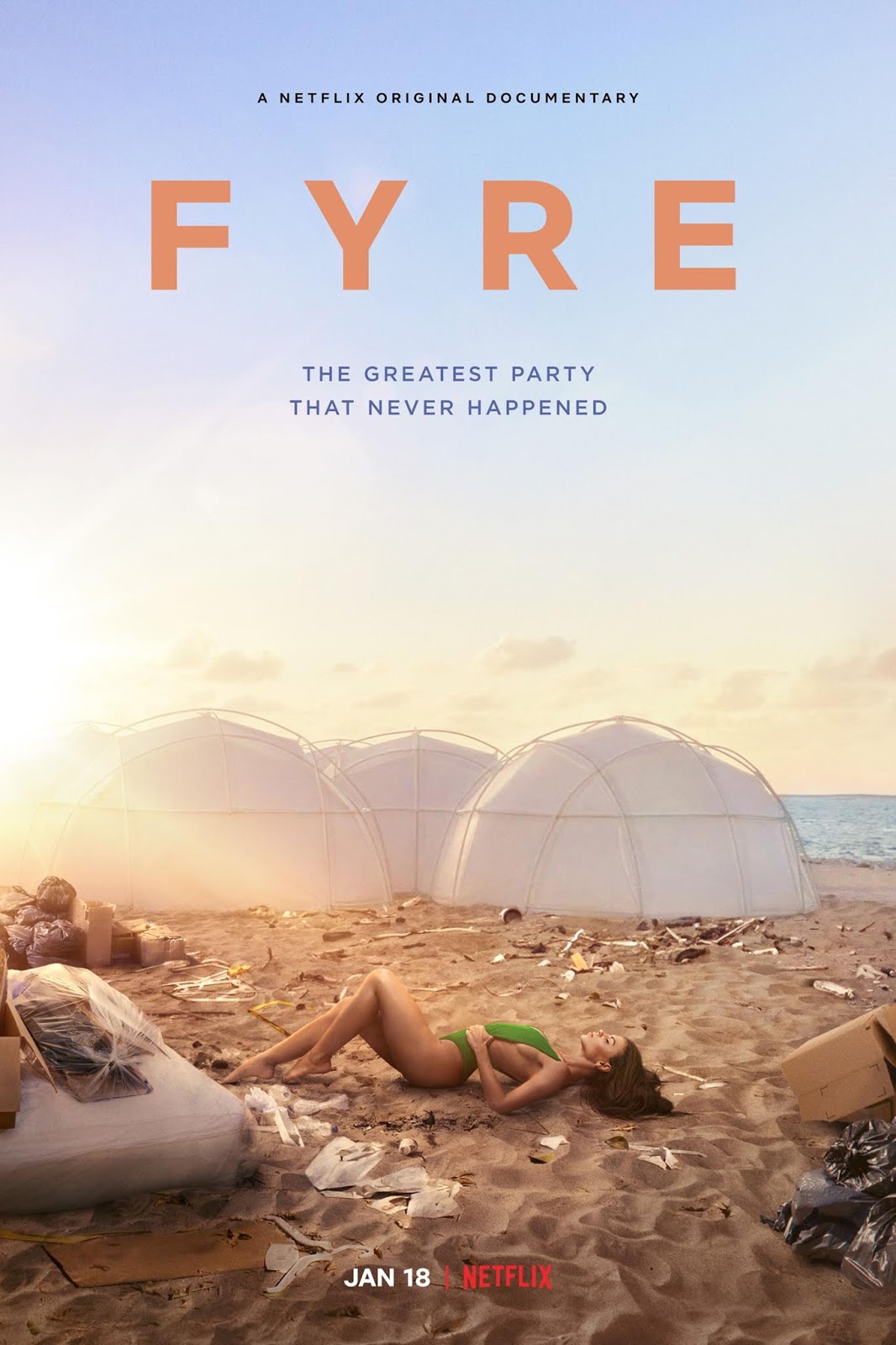
Fyre


2019 documentary

Rating: 12/20

Plot: Details a failed luxury musical festival in the Bahamas.

This is a documentary that makes you think, "Am I as bad as Billy McFarland if I cheered under my breath when all these stupid rich millennials didn't get mattresses and had to eat cheese sandwiches?"

I probably shouldn't have watched this because I don't like to be reminded that people like this exist. 

Touki Bouki


1973 African romance story

Rating: 16/20

Plot: A couple in Senegal decide to escape Senegal and travel to France by any means necessary, including crime.

Don't be fooled by the cute title because within ten minutes, there are two graphic scenes involving the slaughtering of animals. A cow is slaughtered in a slaughterhouse, most of the screen filled with red, and later, the audience is treated to a scene where a goat is killed. I would much rather watch a human die than an animal any day, so these weren't exactly easy scenes. But they set the stage, giving an abstract exposition that helps make the characters' decision to flee make sense.

The film starts dialogue free, and like all of the best movies, it probably could have survived without a single line of dialogue. The first spoken words are actually "Oh, shit," similar to what I said when I saw how much blood can come from a cow's neck. Early visuals, straddling the line between documentary and drama, are striking, painting this world that a spoiled American like me can barely imagine really exists. The style really stands out. The narrative structure is experimental, the editing amateurish, and the editing consistently surprising. This was Djibril Diop Mambety's first movie (of two feature-length films), and it's not a surprise that he's not a classically-trained filmmaker. It feels like he's inventing his style as he goes, and there's almost an outsider artist quality to Touki Bouki that really appealed to me.

The guy has a bitchin' motorbike with a cow skull on it. She's escaping a cackling lady who dances with a knife and screams, "Now kill the goat!" Together, they chase a dream, one floating through the air in the form of a looped snippet of a song about how Paris is "a little piece of heaven on earth" It's a beautiful and possibly heartbreaking love story, sort of like a more chaotic Jarmusch.

Favorite part: a taxi cab driver's reaction to seeing a skull.

Silent Saturday: Spies


1928 spy movie

Rating: 16/20

Plot: Spies doing spy stuff. With a romantic subplot mixed in.

Add this to the "Things I Like Seeing in Silent Movies" list that you probably have on some document somewhere: people biting coins. Here, it's a kid who does it, and I think that might make it better.

IMdB tells me this is a 90-minute film. The version I watched was an hour longer than that, and I'm not sure how it could have been abridged without it winding up completely incoherent. I don't do well with spy intrigue anyway. Even dumb spy movies confuse me, probably because I've never thought of double-crossing anybody in my entire life. Fritz Lang's Spies did confuse me, but it was never in a way that hurt my enjoyment of the movie.

Most of the stand-out sequences are in the latter half of the film. Most thrilling is a sequence involving a train crash, and even the aftermath, with its gnarled train parts, is great. Also great--coconut bombs. Also great--an ending that doesn't really mesh with the rest of the movie or make all that much sense. Most great of all--Lang-regular Rudolf Klein-Rogge's hands. Villainous hands!

This isn't as good as the best spy movie from the 20's--Keaton's Sherlock Jr.--but few things are as good as that. It wouldn't surprise me to find out that this thing was very influential, however.

High Flying Bird


2019 sports movie without the sports

Rating: 10/20

Plot: A sports agent tries to keep his head above water and help his players survive a professional basketball lockout.

The best part of this movie is a scene where Kyle MacLachlan blows a snot rocket. That can't be a good thing.

I'm not sure what Steven Soderbergh is doing with these iPhones, but I don't like it. Opening dialogue is shot from all these odd camera angles that really don't add anything at all. Later, there's a conversation with five people in an office, and the camera work is about as bad as I've seen in a long time. I'm talking inept filmmaker bad. One shot that sort of typifies the way this movie is shot is one where characters at a bar are partially obscured by three glasses filled with limes, lemons, and cherries. Why? What's the point?

This was written by Tarrell Alvin McCraney, the screenwriter for Moonlight. The script wasn't as bad as the camerawork, but it wasn't as good as you'd expect from the screenwriter for Moonlight either. Sports jargon and street slang seemed forced in. The acting didn't help, some performers saying almost every single one of their lines like it was the most important thing that's every been said or will ever be said. Bill Duke, who I recently saw playing a very creepy character in Mandy, is playing a not-so-creepy character here. I enjoy seeing him. And I really think Zazie Beetz has that "it" that will make her always worth watching. Others were not so good.

There were lots of references to slavery in this, and while I think the ideas behind this movie were good ones and definitely worth exploring, it really should have been done with more care. It's a poorly-told story with incomplete characters . Poorly written, poorly shot, and poorly edited, this is the film equivalent of a double dribble.

At least I enjoyed the two Richie Havens songs that bookended this movie.

I'm going to pat myself on the back for that basketball reference and then go to bed.

Jeanne Dielman, 23 Quai du Commerce, 1080 Bruxelles


1975 character study

Rating: 17/20

Plot: Three days in the life of a single mother who makes ends meet by turning tricks.

You've never seen a movie like this. It's bold, daring you to be patient during the minutia. There's no dialogue at all for the first 16 minutes, and there's little interaction between the movie's characters for the duration of its 3 hour and 20+ minute running time. Instead, you just watch Jeanne Dielman going about her day--cooking things, making coffee, cleaning up, running errands, having sex with customers behind a closed door. It's a movie you watch where nothing at all seems to be happening. And then there's a potato issue. And then a catastrophic dropped spoon. And things spiral into an almost invisible out-of-controlness.

Chantal Akerman's the brave filmmaker, and Delphine Seyrig is the actress whose performance helps her make this work. There's this amazing subtlety to what Seyrig does with this character, these barely perceptible nuances that fill you in on exactly what is going on. It's such a great performance. Seriously, just watch a scene where Seyrig is sitting alone at a table for about 9 minutes and tell me there's a better 9 minutes of a woman sitting alone at a table out there.

I wouldn't want to spoil anything. If you watch this, stick with it, appreciate its attention to detail, and know that something will eventually happen. It always does.

I'd love to discuss the feminist message of this film. Somebody help me out?

La Haine


1995 drama

Rating: 16/20

Plot: Following a riot and the shooting of a friend, three guys have a wild 24 hours.

There's a floating shot during a sequence where a D.J. scratches this "Fuck the Police" song that reminded me of something in Soy Cuba, one of those beautiful and impossible shots that I would have assumed was accomplished with the aid of a drone if this wasn't a movie from the mid-90's.

This is a tough movie to watch because you assume from the beginning that things won't end well for at least one and maybe every single one of these characters. And they're not kids, but they're kids, and that makes the unfolding, kind of aimless storyline a tough one. If it wasn't peppered with so many comedic moments, it would have been too heavy, too angry, or too whiny. Instead, it's got a scene with the old guy talking about how there's nothing like a good shit one moment and his friend freezing to death in the next. And it's got these little moments of everyday magic, cows and breakdancing as magical realism. And it's got a guy whose wife has left him dancing on top of a cop car.

For a film following a trio of doomed characters around, this has a vibrancy or energy that really makes it appealing. It balances tones so well. The characterization goes just deep enough, the trio becoming a little more than just caricatures and evolving into three guys you care about and root for even when they're making really dumb or dangerous decisions.