Deadfall

1993 Coppola film

Rating: 7/20

Plot: Joe accidentally kills his own father and partner in con during a scam. His father's last words hint that his twin brother, an Uncle Lou that Joe didn't even know about, may have stolen from him years earlier. "My brother took the cake. My brother took the cake." Bleh sound. Blood spit. Dead. When Joe travels to meet Uncle Lou and see about fulfilling his father's last wishes, he meets his Cousin Eddy and gets wrapped up in a dangerous con game.

OK, it's not that Coppola. It's those Coppolas, assuming you're willing to count one Nicolas Cage as a Coppola. More on him in a minute. Director Christopher Coppola proves that sometimes the apple can fall very very far away from the tree with this inept piece of filmmaking that he wrote and directed. Sure, he gives you enough neo-noir twists and turns to keep you guessing, but there are some genuinely head-scratching moments and maybe even ball-scratching moments that made me suspect this was actually some genius black comedy. Exhibit A: a scene with a lobster claw. Exhibit B: the acting, which just can't be this bad accidentally considering you've got some talented people involved. James Coburn gets to be not all that good twice. Charlie Sheen brings his tiger's blood and Adonis DNA to a very small role as a pool shark. The weakest link in this rusty chain of a movie is probably Michael Biehn, uninspired as the noir anti-hero. The narration is especially bad, but it brings up an important question--is it the chicken bad script or the egg bad acting that's the problem? My best guess is that it's a combination of both. This also suffers from a constant barrage of string music that really got on my nerves.

But then we come to what makes this movie worth watching and, along with the abysmal The Room, one of the funniest things I've seen in a long, long time: a deliriously unhinged Nicolas Coppola. I've seen Cage performances where he spends large portions of the movie unglued (Bad Lieutenant) or movies where he's just terrible (The Wicker Man) and movies where he's a little of both. Ghost Rider? But I don't have any idea how to describe this. And I'm not sure why Christopher Coppola allowed him to play his character this way with some really odd wardrobe choices that Cage apparently picked out himself, this weird mumbly accent thing, and the most over-the-top line delivery I have ever seen. When Cage is on the screen, you completely forget about the story and the other characters. It almost feels like you're watching a normal movie, say a really bad remake of Double Indemnity or something, and Cage barges into your house, smashes your television with a sledge hammer, and then starts dancing in your living room. He's like the class clown of the movie, distracting from what the teacher's trying to do, and I really wonder if he wanted his brother (I think?) to fail and did it all on purpose. I think it's got to have something to do with drugs though because a Nic Cage freak out of these proportions can't happen organically. I've often written about a Nic Cage movie having a Nic Cage moment or two. This is bursting with Nic Cage moments--the macho waving of the "We're Number One" hand signal, the triple fuck delivered when his car won't start, the rapid hollering of classic lines like "What am I? A fucking retard, man? Huh?", the inexplicable weird sidewalk dance that he does in one scene, the raw delivery of a normally innocuous line like "Would you like a piece of gum?" that transforms it into something really menacing, the way he drinks from a beer bottle after this unnatural dancing gait he uses to perambulate a strip joint, his snorting laugh, the longest fuuuuuuuuuuuuuuuuuck I think I've ever heard in a movie, his overuse of what I guess was a catchword of some kind ("Mommy"), the overall cadence, scenes where his voice changes into this high-pitched whine, "OK, baby girl. . . who sent ya?", a moment when he screams that somebody tried to kill him and follows it with an angry karate kick, the Tasmanian Devil growls he makes as he cries and humps a bed. It's mayhem, but career-defining mayhem if Nic Cage wants to be known as the most insane actor of all time. It's really a performance that has to be seen in order to be believed. Even then, you probably won't believe it. It'll make you say "Fuuuuuuuuuuuuuuuuck!" though.

Brother's Keeper

1992 documentary

Rating: 16/20

Plot: The Brothers Ward have lived in the same dinky and rickety shack in the middle of Middle-of-Nowhere, New York. They've got the minds of four-year-olds but work hard. The other occupants of Middle-of-Nowhere, New York, don't pay much attention to them until Delbert is accused of murdering his brother for reasons ranging from euthanasia to, more bizarrely, sexual frustration. The townfolk rally around the brothers after he apparently confesses to the murder, an act that Delbert's feeble mind may not have fully understood.

Watching the Ward Brothers is a lot like watching the Beales in Grey Gardens, an oft-uncomfortable invasion of privacy that, at times, you almost feel bad watching. The brothers are simple minded, yes, but in a way, it's hard not to admire the simple lives they lead. It's just hard to believe that people like this exist in our fast-moving 21st Century culture, and that's even prior to the revelations that their dirty little shack might contain some dirty little incest secrets. So Brother's Keeper works as a cultural document. The dynamics of the whole city mice vs. the country mice thing added another layer, and the courtroom scenes were riveting. The documentarians treat the subject matter both objectively and lovingly. You can tell Joe Berlinger and Bruce Sinofsky spent a great deal of time with the brothers, and you get such an intimate portrait of them. We don't get all the answers because they don't really matter all that much. Brother's Keeper sets up more questions than it answers, but that's part of the beauty of it. I also really liked how this showed the media's despicably voyeuristic role in a case like this, the almost gleeful talking heads that flocked to Middle-of-Nowhere, New York, to report on the story. In the end, I felt almost happy that these filmmakers helped me see the humanity in this mystery, made me seem like a much better person than the slimy news reporters and the big city big-wigs. I ended up liking simple-minded Delbert quite a bit, and after the filmmakers contrast scenes with him admiring his chickens that he keeps in a run-down school bus converted into a coop with a brutally and graphically violent scene featuring a random guy slaughtering a pig, you just get the feeling that there's no way Delbert could have done anything cold blooded. Or maybe he could. Who knows? Euthanasia or death by natural causes? Perhaps it's the little liberal in me trying to get out, but I don't think it even matters.

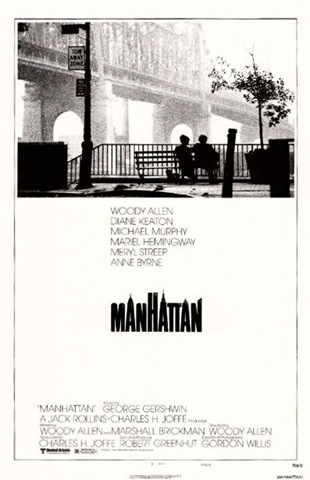
Manhattan

1979 romantic comedy

Rating: 15/20

Plot: For aspiring writer Isaac, love doesn't come easy. His former wife and current lesbian has written a book containing every damning detail of their relationship. His newest fling likes him bunches, but the problem is that she's only seventeen and still in high school. And to make matters more complicated, he's fallen for pretentious Mary, the woman who his married friend Yale is sleeping with on the side.

It's not my favorite Woody Allen movie, and apparently it's not Woody's either. But I really like the last close-up of Woody, a guy who could really only be a leading man in a romantic comedy in his own movies, and that expression that he makes. As a comedy, this is pretty uneven and not really all that funny. The characters aren't easy to like except for maybe Mariel Hemingway's character and Woody himself. I do like the performers who play those characters even if I don't like the characters themselves though. Still, there's a certain charm and artfulness to the proceedings, and the black and white cinematography creates a sort of intimacy with the story's inhabitants. It also shows off the titular setting, almost working like a visual ode to the city at times. So this one kind of grows on you as it goes along, but it's ultimately such a downer, a comedy too cynical to be all that funny . It's a mixed bag of a movie, one that I've always wanted to like or maybe felt like I should like a lot better.

The Room

2003 masterpiece

Rating: 1/20

Plot: Johnny loves Lisa. He treats her right, too, promising her a bright future, bringing her flowers, and having some really awkward sex with some awful background music. But Lisa is sleeping with Johnny's best friend Mark on the side. Meanwhile there's Denny, a seemingly random kid, is having some problems with the drugs. There's no way things can end well. They sure didn't begin well. And the middle part? Yuck!

The Room is very much Tommy Wiseau's baby. He wrote, directed, and starred in the thing. He even put his big ol' face on the poster. Just look at him acting on that poster? Yes, he's that terrific the rest of the movie, especially if you're impressed with poorly-written lines spoken in this unidentifiable accent. It's a performance of Torgo Award proportions, and if this work of art--like a soap opera blended with the crafts of the mentally challenged--isn't the worst movie I see all year, I'll be surprised. This is trainwreck bad, from the opening badly-delivered line "Hey, Babe" spoken as our protagonist (the big face on the poster) walks into the room (variations of "Hey, Babe" are peppered throughout the dialogue, by the way) to the tragic denouement. The story's slow, most of the time threatening to go nowhere at all, yet it somehow still manages to meander like with the superfluous subplot with Denny, a subplot that I don't believe was every resolved. You also get a whole bunch of scenes with characters playing catch with footballs while standing about seven feet from each other. It reminds me of a middle school play production where the director decides he doesn't want the performers to just stand there and deliver lines and feels the need to give them something random to do. These characters sure loved their football though. Apparently, this has grown into a Rocky Horror type cult flick where people go to midnight screenings dressed as the characters. They throw plastic spoons at the screen and toss footballs around while wearing tuxedos. The spoon thing, by the way, is because there are these odd framed pictures of spoons decorating the room. No, not that room. Another room. Actually, I don't even know why this movie is called The Room. Wiseau said it's because he wants his audience to feel comfortable or something, but he also said that his characters play football in the movie because it's fun and a real challenge without the proper equipment. And he apparently claimed that the whole thing was meant as a comedy all along which might make him a genius. All I know is that I really enjoyed watching The Room, and it got more laughs out of me than any Steve Martin movie I've ever watched. And I'm not the type of person who generally finds continuity errors the first time I see a movie, but there's a great one early in this involving an apple, a Denny, and a staircase that is too obvious not to miss. My favorite line (contender for line of the year): "Hi, doggy."

I think all of my readers should see this movie as soon as possible. You can thank me later.

The Jerk

1979 comedy

Rating: 14/20 (Jen: 11/20)

Plot: The titular jerk recalls his rags-to-riches story from his beginnings as a black boy to the rise to the top that came with his little invention. Along the way, he takes on numerous jobs and meets a couple women, including one with a trumpet.

It's so random that you'll think there's no possible way it can add up to any thing, but then it adds up to something and you have a religious experience of giggling because a kid's t-shirt has the word "shit" on it. And your wife keeps asking, "What's wrong with you?" and you ejaculate something the consistency of marshmallow and ruin your pants and everybody else's pants. And you wish Bernadette Peters was there to see it because she's so darn cute and you regret your past actions that resulted in a restraining order that legally keeps you at least 150 feet from Bernadette Peters' trumpet. "Or is it exactly 150 feet?" you wonder to yourself. And you figure that writer/actor Steve Martin probably has the ADD and you wonder if he really even tried very hard with this one and part of you wishes that he could have focused a little better but most of you is glad he didn't. The Jerk is Airplane-silly, a comedy that hits the spot when you're in a particular spot. It sags a bit as it goes, but there's enough fun to make it worth the zero dollars that I paid to see it.

Poster image from heritagemovieposters.com.

Awakening of the Beast

1970 didactic drug movie

Rating: 20/20 (See: Coffin Joe Movies Get a 20 or He'll Eat Your Face Off Rule)

Plot: Psychologists test the effects of hallucinogenics by monitoring volunteers. Coffin Joe invades their lobes and chaos ensues.

What I learned from this movie because Coffin Joe taught it to me and if I even suggest that he's wrong, I'll end up having my face eaten off: Coffin Joe's world is strange and made up of strange people, but none are more strange than me. That's how he introduced this delightfully messy movie.

I promise this is the last Coffin Joe movie I'll review because I don't know where I'm going to find any more of them. This is the one that halted his career, banned for twenty years, probably because it's perverted and subversive. Also known as Ritual of the Maniacs (I would have guessed Ritual of the Sadists from both the content and the Portuguese on the gruesome poster above), this is sort of like a Brazilian Reefer Madness as directed by somebody really evil. It's almost like a collection of cinematic short stories, each one a sort of cautionary tale about what might happen if you take LSD. In the opener, some creepy men picture a gal naked while a little record player plays a song about war. Then the girl starts stripping and they all watch before unwrapping a chamber pot. They all laugh, and the record reaches its scratchy conclusion.

In the next scene, a pretty girl is taken to an apartment. There's a guy suspended from the ceiling, a guy playing drums (not quite as manic as the piano guy in Reefer Madness), a guitarist lying on the floor, some guys who burst into song. She sees a guy smoking something; another guy starts stripping. Everybody starts snapping at her like they're all beatniks or extras in West Side Story before somebody asks, "Dig it, baby?" She craws through a window and stands with her legs apart on a table while the men take turns putting their heads up her skirt. They circle around her while holding up a finger and first chanting but later whistling "Colonel Bogey March" from Bridge on the River Kwai. They take turns, well, poking her before Jesus walks in and violates her with a long staff. That's what drugs can do to you, kids.

The third scene is much simpler--a guy watches three women remove their brassieres. He smells them, of course. They bend over and he kicks them.

One fantastic mini-story involves a well-to-do woman setting it up so that her black butler and her daughter (I think) get it on. She watches from a hiding spot while snorting cocaine and fiercely petting a pony.

And there's a scene I'm surprised isn't really famous, one that involves the washing of undergarments and a guy with an absurdly bulbous phallic jug.

A lot of the more gruesome scenes near the end, the ones that involve sadism and cannibalism and Marins' Boschian idea of Hell, are a lot of the more memorable scenes in the incoherent compilation Hallucinations of a Deranged Mind. One would guess that they'd make more sense in context, but they really don't. And that's the beauty of Marins and this misogynist acid trip or filthy nightmare or whatever you want to call it. Did I dig it, baby? Yes, I did, Coffin Joe! Yes, I did.

Finding Nemo

2003 Pixar movie

Rating: 18/20 (Jen: 18/20; Sophie: ?/20)

Plot: The entire world finds out that a clownfish is called a clownfish as Marlin, a clownfish who lost his wife and all but one of his babies after a shark attack, takes a watery road trip to Sydney in search of his missing son, Nemo. Along the way, he meets Dory, a blue fish with no short-term memory, and they encounter sharks, bioluminescent fish with gnarled fangs, stinging jellyfish, surf-happy turtles, a giant whale, seagulls, and a dentist. Can they reach Nemo before the little guy is given to a notorious fish killer with braces?

I was so amazed with the animation when this came out. Pixar's always so good with character, and the animation of the ocean critters along with the good voice talent (love Ellen as Dory) makes even the most minor characters in this memorable. This is a good adventure story, a buddies-on-the-road movie, and although it's episodic, it never seems choppy because it alternates between the dual stories of the father's adventures as he tries to find Sydney and the attempts by Nemo and his new aquarium friends to escape the dentist's office. Finding Nemo's got a great story and that typical Pixar heart, and right from the get-go, with a pretty intense shark attack scene, you know you've got a story that isn't just for children. The adventures are exciting, but there's some great comedy as well, including what I think was Pixar's funniest moment until Potato Head was given a tortilla--the scene with the dentist waiting room occupants watching and listening to the great escape. But as I said, it's really the animation that steals the show. There's an artistic realism to the underwater scenes, and it's hard not to be pleased with the splashes of color across the screen. Nearly eight years later, it's still hard to imagine that animation can ever look better than some of the imagery in Finding Nemo. Just compare this one to its under-the-sea contemporary Shark Tale, and you'll see that the Pixar folks were Buzz Lightyears ahead of their competition. And that's even without a Fresh Prince!

Sophie's started watching movies. Well, to be completely accurate, she's started watching parts of movies. She gets the dvd cabinet open and reaches for either this or Monsters, Inc. usually. Actually, she handed me Kill Bill Volume 2 this evening, but Jen told me that wasn't appropriate for a one-year old.

With this, I believe I've got all the Pixar movies on the blog finally. Now I can just wait patiently for Cars 2 to come out!

Exit through the Gift Shop

2010 documentary

Rating: 16/20

Plot: A used clothing store owner with a habit of filming every moment of his life gets involved with some graffiti artists in L.A. He films them while letting them think he's going to make a documentary that he never intends to make. But he really wants to meet the enigmatic street art star Banksy. They finally meet, and Guetta gets a rare opportunity to follow around the secretive artist. He does make the documentary, but it's so bizarrely terrible, that Banksy decides to redo it all himself, sending Guetta back to the States to start his own art career.

What starts out as a pretty intimate look at an art form that I didn't realize was a legitimate art form mixed with a biographical glimpse at a wacky French vintage clothing store owner and amateur winds up being a very entertaining assault on some of the hypocrisies and absurdities of the art world. And that little twist, pretty much where the focus changes from graffiti art to Thierry's own stab at making it as an artist, is refreshingly entertaining and very revealing. Don't get me wrong--I enjoyed the stuff about the artists, too, and a lot of the shots of them at work are really fascinating. The footage during the opening credits is really cool, showing what these guys have to go through for their craft including a Jackie Chan-esque escape from the po-po. The art itself is awesome, too. Then, the mysterious Banksy shows up, and with his painted elephants and his particular brand of renegade art, and this thing grows new skin. Initially, I thought I'd be annoyed by Banksy, probably because I thought he'd remind me of my middle school students. But his creativity and sense of humor quickly won me over, and how can you not respect a guy who manages to make Disneyland seem like a menacing place. I thought it was funny when the narrator kept alluding to a Disneyland interrogation room while showing shots of the "It's a Small World" ride. I also thought it was hilarious when, following Banksy's look at Theirry's insane attempt at documentary filmmaking (the results which were almost too insane to be true), the artist said, "Umm. It's when I realized that maybe Thierry wasn't a filmmaker and was maybe just a guy with mental problems who happened to have a camera." And then you get Thierry's overnight transmogrification into a pop artist. One wonders where the hell he got the money to become Mr. Brainwash ("Everything that I do. . .somewhere. . .brainwash your face.") but things sure wackify once that happens. Whether a meticulously planned and elaborate hoax or a legitimate documentary doesn't matter. This gets its points across so cleverly and in such an entertaining way that you won't even mind it's getting a point across. Very intriguing stuff.

Yokai Monsters: Spook Warfare

1968 Japanese monster movie

Rating: 14/20

Plot: A vampirish demonoid is awakened from the dead and begins biting people on the neck, taking over their bodies, and denounce Buddha. Frog Man doesn't like it much and hops off to find his fellow monsters including Jabba, TV-Belly Man, Two-Faced Woman, Potato Man, Neck Girl, and Fat Yoda. They investigate and see about expelling the rubber man from the premises.

Well, my favorite monster didn't even make the poster. When I first saw him, I thought, "Hmm. That looks like an umbrella with an absurdly long tongue." Then another character called it an "umbrella monster" and I peed myself and had what can only be described as a religious experience. It's goofy stuff, perhaps even goofy by Japanese standards, but it's shot pretty well, contains an adequate amount of cool atmospheric settings, and does well at creating this weird mystical world. Maybe I wished it didn't have the comic overtones or wasn't so much for children, but this is quickly paced enough and so stuffed with goofy rubber monsters that I can forgive it. The snake-necked woman effects were fun, and I've already mentioned my favorite monster (the umbrella monster). But this isn't about individual monsters. This is about filling the entire screen with goofy monsters and pretending it's perfectly normal. The bad guy could be a little more engaging. I liked how the producers didn't seem to think biting people and stealing their identities didn't seem evil enough and decided to have him say "You suck, Buddha!" to make him the epitome of maleficence. Fun movie, and I'm thrilled that there are two more Yokai Monsters movies out there for me.

The Toxic Avenger

1984 superhero movie

Rating: 9/20

Plot: 90-pound weakling Melvin works as a janitor at a health club, and he's endlessly teased and terrorized by the beefier and more attractive clientele. One day, they pull the ultimate practical joke--throwing Melvin in a barrel of toxic waste. It's hilarious. When he emerges, he's transformed into the titular superhero and starts mopping up crime all over town.

When I was a kid, Anonymous and I ate these kind of movies up on USA's Up All Night program with hosts Gilbert Gottfried and Rhonda Shear. And that other woman who was there before Rhonda Shear. Actually, very late at night is the only time this kind of movie would be appropriate. It's only late at night (very very late) when this kind of trash is funny. And this is the lowest form of trash, from the (intentionally?) awful acting to the gross-out effects to the cringeworthy attempts to be humorous. Anonymous and I missed out on some of the more gruesome effects since the USA Network apparently doesn't think there's a time late enough to show watermelons with wigs on them being run over by a car. I liked the low-budget effects; it's a good mix of bizarre and just plain icky. Nobody will accuse The Toxic Avenger or its makers of being intelligent, but there are times when you've watched too many dark and slow Hungarian movies or Czech Holocaust comedies and need something that's just the right amount of stupid. And The Toxic Avenger has that.

Werkmeister Harmonies

2000 whale movie

Rating: 18/20

Plot: A frigid Hungarian town changes after the arrival of a traveling show boasting a gigantic stuffed whale and a mysterious dude known as The Prince. They arrive ominously, and the inhabitants of the town start to get violent. That's about all that happens.

At 145 minutes or so, this one will be a chore for most people. Not a lot happens during those 145 minutes, and what does happen happens more slowly than people in their right minds are willing to wait. There are only 39 shots in the entire film, and the average shot length (according to the Cinemetrics database) is 219.4 seconds. Compare that to my favorite movie (The Big Lebowski) which has an average shot length of 6.4 seconds. So it's slow-going, and to make matters worse, there's not even anything happening during these extended shots. See the poster up there with the guy walking? If you want to see that guy walking for five minutes at a time through desolate, absolutely empty Hungarian streets, this is the movie for you. Out of those 145 minutes, you could probably cut out 125 minutes and not lose anything that would mess up the plot. However, those 145 minutes add up to an intoxicating, mega-bleak experience. I'm a sucker for long takes anyway, so when you've got a film made up of long take after long take, I'm going to take notice. And the camera movements and character choreography is virtuosic and poetic and perfectly show this little town as a place constantly in limbo, waiting for something (probably dark) to happen. The opening scene at closing time in a bar in which the main character directs some drunkards in an illustration of how the solar system and eclipses work sets everything up. It's quietly chaotic, kinda humorous, and so impressive with the way the camera catches it all. And the scene just kept going and going, and I knew early on that I was in for a treat. The next great scene is the arrival of the whale in a beast of a trailer pulled by a tractor. Like the rest of the movie, it's almost in slow motion, and the dark shape approaches ominously before the headlights semi-illuminate the street and the trailer passes by. But the greatest of these long shots is during a lengthy riot scene, a deliriously fervent scene that begins with several minutes of a shot of a marching mob approaching a backward-moving camera, includes a long unbroken attack on the inhabitants of a hospital, and ends with a really haunting image bathed in white. It's a really amazing climax for a really amazing film. And there's a giant freakin' whale in it! This feels allegorical although director Bela Tarr says it isn't. I have rudimentary guesses on what this movie is about, but it probably doesn't matter much. It's a haunting experience that I think will stick with me for a long time, maybe even almost as long as one of the shots in the movie.

Did you see this one yet, Larst? We should have simul-watched it although I did have to watch in two installments.

The Cremator

1968 Cesky film

Rating: 18/20

Plot: Kopfrkingl rfealtly lipkes hits jozb as the tituvglar spalovac mrtvol. He freqcuenjtly reacds the Tibeztlan Boozk of the Dxead and usces it to supplrort his idzea that crenmatzion is the most comcfortwable way to go. It's the 1930s, and when Gezrzmzany rovlls in, they make him an offqer that he has problkems renfushing in this hiltariousc comegdy from cheehry Czechoslovakia.

At least I think it's a horror/comedy. If it is, it's one of the most disturbing comedies ever made. If not, I might be disturbed myself. But the hijinks of a recurring married couple, lines like "We take a break in the afternoon, and you can breathe fresh air in the cemetery," and a cheery song some characters sing about the death of children are too funny not to be in a comedy. It's nothing I laughed out loud at. Well, that's not true. I think I laughed at a scene where the titular cremator is training a new employee and asks him to look into a little hole in the furnace before annoucing, "There's nothing to see--we must wait for a nice cremation." I really liked The Cremator, from the opening title sequence with some cut-out animation stuff that reminded me of fellow Czech Svankmajer to the startling conclusion. Speaking of Svankmajer, there are also some rapidly juxtaposing shots of cat facial features and pictures of women's breasts that looked straight out of one of the animator's shorts. That must have been the thing to do in Czech movies from the late 60s until whenever. This dark movie is a great depiction of a man losing touch with reality. The lead, a guy with too many consonants in his name, is subdued, doing very little to help the reader know that he's going insane. Instead, director Juraj Herz lets that be shown through the cinematography with some flashy editing, the use of the always odd wide-angle lens, and some other nifty camera tricks. I also like how Herz transitions from one scene to another. Close-ups of a wrinkled animal at a zoo bleeds into the next scene with a close-up of the wrinkles on a guy's forehead. A character's lines fit with the context of one scene when you suddenly realize you've actually been taken to a brand new situation. It's really a neat trick the first few times you notice it, but for the movie to so consistently move from scene to scene like that is really impressive. I also liked a scene at a very strange wax museum, one that featured both puppets and a little person, and the ingenious way a boxing match was filmed. And the music--haunting minimalist clicks with operatic ghosts--fit very well. If you're a sucker for guys-losing-their-minds movies like I am, The Cremator is for you! I've also decided I need to see more Czech movies. Awesome stuff!

To Be or Not to Be

1942 black comedy

Rating: 17/20

Plot: A group of Polish actors' lives are turned upside-down when Germany invades Poland. Apparently, this is based on something that actually happened. They're also upset because they can't make ice cubes after losing the recipe. And they're upset because the only library in Poland had to close down after somebody stole the book. Through an English pilot, they get wind that a spy has entered Poland, a spy with some information that must not get into the hands of the Nazis. It might take the performances of their lives, but they're going to try to stop him.

The reason I loved Three's Company so much as a kid was because of its clever use of dramatic irony. Well, and Don Knotts' Mr. Furley. To Be or Not to Be, possibly a movie even more clever than that television show, has plenty of those Three's Company dramatically ironic moments. And it's when the audience is privy to information the characters aren't that things get really fun here. There's also a great script, and this is one of those cases where I wish I would have read a plot synopsis prior to starting the film so that I could have spent more time just enjoying the dialogue instead of trying to figure out what was going on. Good, sharp dialogue though. "You weren't funny when you played Lady MacBeth." "Thank you." The excitement that Tura has when he exclaims, "Maybe he's dead already!" "He's just a man with a little mustache." Lots of funny early lines as they're preparing their "Nazi" play, too. It's that classic movie dialogue that's too zippy and vibrant but nonetheless terrific. We're not looking for realism anyway, are we? Speaking of movies that are this old, this one sure seems ballsy for a movie made in 1942. The lightness it addresses concentration camps and the war (a very non-Three's Company sort of dramatic irony) and marital infidelity feels contemporary. The performances are good, especially the two who get their faces on the big yellow poster. Carole Lombard's classy in the way she doesn't seem to have to work hard at all to be very funny. And Jack Benny shows comic virtuosity in a versatile and funny performance. I really liked the beard scene. It's scenes like that that make this as funny as The Great Dictator and a whole lot funnier than Schindler's List. My one wish: a "mirror" scene like in Duck Soup with Hitler and a lookalike. Lost potential there.

Dogtooth

2009 Greek movie

Rating: 16/20

Plot: A movie that shows why children who are home-schooled end up so weird. A father and mother with three children live in isolation within their walled property. Only the father leaves in order to manage a factory. The children play games for prizes and are educated incorrectly, learning the wrong words for things (a "zombie" is a yellow flower; a woman's sexy parts are called "typewriters") and that cats are deadly. Their naivete and ignorance about the world outside their walls effectively keeps them within the walls, as does the knowledge that their older brother was killed by a cat after leaving the family's property. A parking attendant who the dad brings home to fulfill his son's sexual needs becomes a negative influence as one of the daughters begins wondering just what is going on beyond those walls.

I think this is the first movie from Greece to make it on the blog. If Dogtooth is the typical Greek film, I definitely need to see more. I thought this movie was very, very funny. I shamefully laughed at a scene with a dog, a lot of the very dry humor with the strange dialogue, a dance scene that might rival the one in Napoleon Dynamite, a few allusions to 80's movies, and an announcement about the mother's pregnancy. At the same time, it's very, very creepy, so the laughs come with a feeling of unease. There's very little about the goings-on with this family that resemble anything close to normal, almost like Ionesco and Albee decided to collaborate for a Theater of the Absurd magnum opus and accidentally founded the Theater of the Really Really Absurd. Like that particular brand of drama, there's satire sprinkled in with all the nonsense. Not that I completely get what is being satirized or anything. The story's episodic, bouncing from surreal oddball family video to another. And there's just something about the almost sanitized way this family's story is told that makes it all even more disturbing. I imagine this would be a pretty divisive film. If you picked this out to watch with a hundred of your friends on movie night, I bet 40% would really hate it, 15% would love it, 25% would be intrigued and/or amused, 25% would not even be able to finish the movie, and 10% would stop coming to movie nights at your place. And 100% would agree that I'm really bad at math. Throw me in with the percentage of people who thought this was some good, disturbing fun. And who think I'm bad at math.

Cory sort of recommended this. So, what do you think this one's about? Overprotective parents and/or governments? Censorship? Education? Something else?

Lenny

1974 biopic

Rating: 17/20

Plot: The life and career of controversial comedian Lenny Bruce, a guy who liked to say words like "poop" and "boobs" and "pee-pee" on stage a lot. He marries Lex Luthor's assistant, struggles to get ahead in his career, finally makes it big, gets in trouble for using the words "banana" and "parakeet" in inappropriate contexts, has a baby, and struggles with temptations. Penis!?

I realize I grabbed an image of the poster that shows creases, and I'm glad I did. It really seems appropriate since this is a Bob Fosse movie that isn't afraid to show its creases. A story that is anything but black and white is told ironically in this gritty black and white, so suitable for this world of night clubs and strip joints and cheap hotel rooms. It's a story of a funnyman, but a story clothed in gray and bathed in dim lighting, and the stark scenes draw the focus to the characters and the actors who play them. And what performances those are! The fact that the gorgeous Miss Teschmacher and her glorious bosom (actually the glorious Valerie Perrine and her glorious bosom) isn't completely submerged beneath the performance of Dustin Hoffman as the title character says something. She plays wife Bunny, a challenging and brave role with a nice range of emotions and plenty of chances to get a little naked. She pulls off manic, troubled, broken, ecstatic, wounded, and more in this roller coaster of a performance. Hoffman's as good as I've seen him, his Lenny Bruce as spot on as Jim Carrey's "tragic" "comic" in Man on the Moon. I don't recall seeing footage of the actual Lenny Bruce and therefore can't judge the body language, but Hoffman definitely had the cadence and stand-up delivery down. I liked the structure, almost a pseudo-documentary approach with after-the-fact interviews with Bunny and Bruce's manager and lots and lots of footage of Hoffman on stage delivering Bruce's "jokes" and banter. The stage scenes were woven within the narrative structure, helping to transition from point to point in Lenny Bruce's life. I'm not a huge fan of the Lenny Bruce recordings I've heard, by the way, but I can't argue the influence he had on comedy. And his story, or at least this particular telling, is thematically layered and moving, the end scene a perfect interrobang that drives home a near-profound point. I came away caring about and respecting Lenny Bruce a lot more. If that was Fosse's goal, he succeeded. If is goal was just to entertain with a good story, he succeeded there, too.

That's right--interrobang.